ACRE Siding Reviews: What Builders and Architects Actually Say (2026)
August 2026Before you spec ACRE siding, you want to know what people who have actually used it think. This pulls together ACRE siding reviews from Modern Mill project case studies, the company’s Google rating, Houzz and builder-forum discussions, and trade coverage from the people who cut, specify, and live with the material.
The verdict is strong on looks, workability, and durability, with one recurring caution about dimensional movement that comes down to how the boards are finished and installed. This is what builders, architects, and homeowners say, and how to read it before you commit.
ACRE Siding Reviews at a Glance
Reviews land strongly positive on three things reviewers keep coming back to: the wood look, how easily it works with standard tools, and how it holds up in wet and coastal conditions.
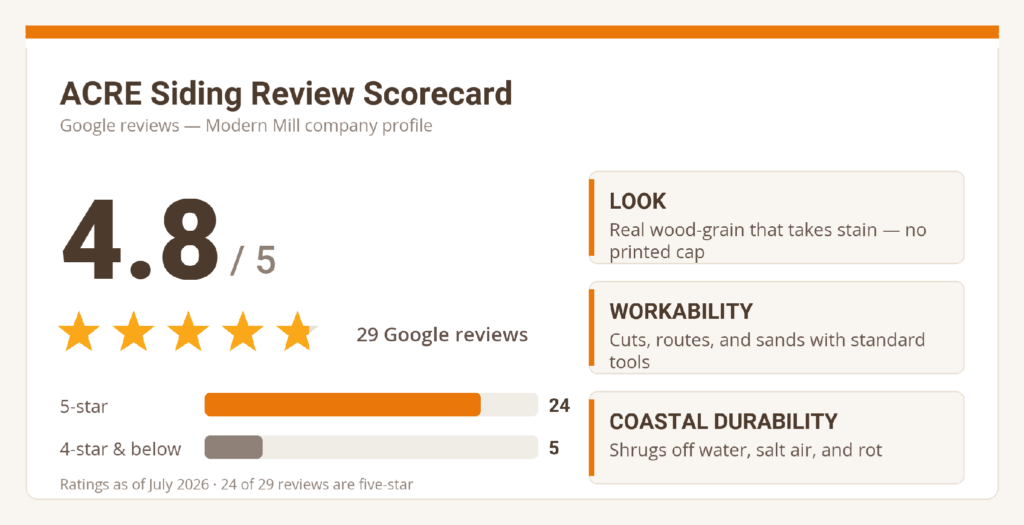
Modern Mill’s company Google profile holds a 4.8 out of 5 rating from 29 reviews, 24 of them five-star. The reviews that get specific point to product quality, siding projects, durability, and ease of use.
| Where ACRE gets reviewed | Signal | What reviewers emphasize |
|---|---|---|
| Google (Modern Mill company profile) | 4.8 / 5, 29 reviews (24 five-star) | Product quality, durability, ease of use, siding projects |
| Houzz and builder forums | Active discussion, mixed | Wood-look and workability praised; dimensional movement debated |
| Trade coverage (Chip Wade, LBM Journal, GreenBuildingAdvisor, Pro Remodeler) | Editorial features and demos | Sustainability story, stainability, machining like real wood |
A pattern runs through them: people who match ACRE to the right job and follow the install specs tend to love it, and most frustrated reviews involve decking, dark field-applied colors, or boards installed outside the guidelines. The sections below break down what each group says.
What Builders and Installers Say
Workability is the trait builders bring up first, and it is where ACRE earns its strongest reviews. It cuts, routes, and sands with ordinary woodworking tools, holds screws and nails without splitting, and throws no silica dust the way fiber cement does. It is lighter to carry than solid hardwood or dense composite, and it can be thermoformed into curves for detail work. No pre-drilling, no special blades.
A GreenBuildingAdvisor writer put the machining appeal plainly, noting the material “will not melt even when cut with a dull blade, it has no toxic gasses or friable minerals, [and] it can take conventional wood stains.”
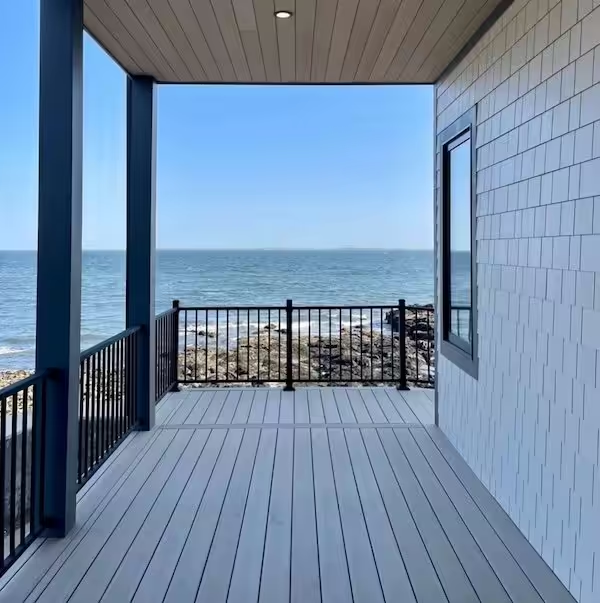
The most-cited builder story comes from Ian Pedersen, the project manager on our Montauk beach house. He was skeptical at first, so he ran his own trial:
“I tried hard to disprove it. I put it out under direct sunlight, buried it, froze it in snow and I even tied it to a rock and sank it in the bottom of a lake for six weeks. After that lake test when I saw that it looked the same as when I first received it, I knew ACRE was right for this special project.”
That is the upside reviewers keep describing: a board that machines like premium lumber but shrugs off water and rot. The caveat that experienced installers add is just as consistent, and it is worth stating up front. ACRE is a composite, so it moves with temperature. Builders who fasten into solid framing (never brads, finish nails, or staples), gap to the installation guide, and acclimate the boards before install report the cleanest results. Most problem posts trace back to one of those steps, and finish color and acclimation matter as much as fastening.
What Architects and Designers Say
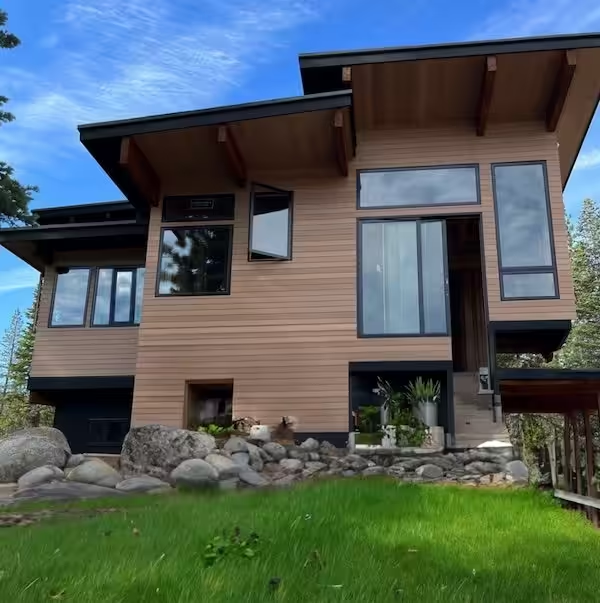
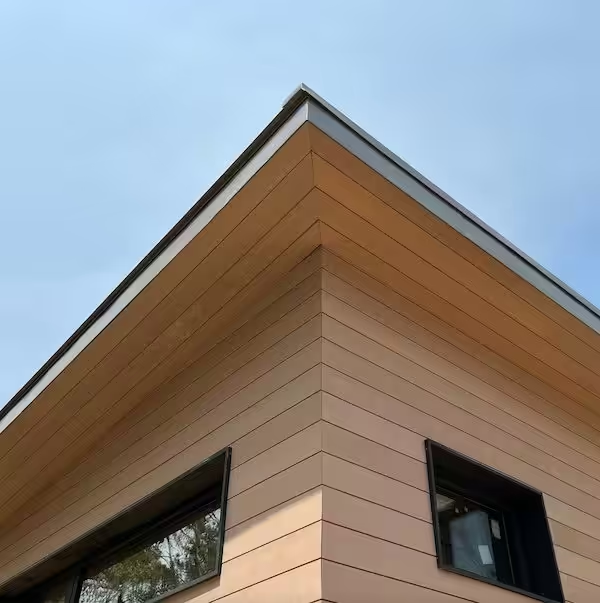
Designers review ACRE on two fronts: how it looks and what it lets them do. On looks, the deciding factor is that ACRE takes real stain rather than wearing a printed grain cap. There is no plastic-looking shell to give it away, so the grain reads as genuine and can be tuned toward cedar, ipe, or mahogany.
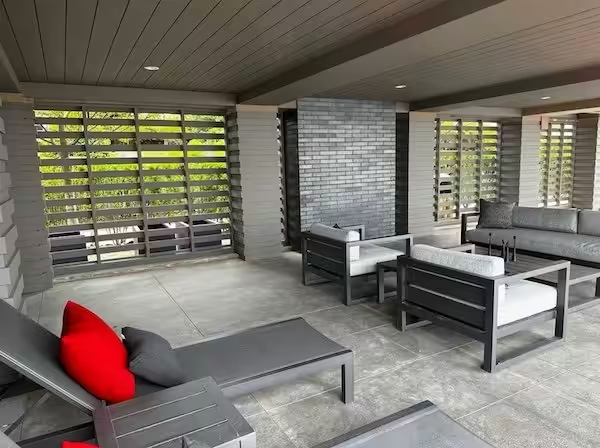
The design freedom is the other draw. ACRE can be thermoformed into curves and custom profiles, milled into matching trim, and finished to tie interior and exterior wood together. The design-build team at Caplow Manzano used ACRE trim on a Miami project and summed up the reaction it gets:
“After complimenting the looks, people touring the home want to know what sort of wood we used. They are always intrigued and impressed when they learn that it’s not wood at all.”
Sustainability is the third factor architects weigh, and ACRE’s makeup is unusual: it is built largely from upcycled rice hulls, an agricultural byproduct, and it is tree-free and free of phthalates, phenol, and formaldehyde, made in a zero-waste facility in the United States. Green-building reviewers do debate the polymer binder that holds it together, and that is a fair conversation to have on a low-carbon spec. For most projects, the appeal is simple: a real wood look without cutting down trees.
For coastal and fire-prone work, two credentials stand out. ACRE Shiplap Siding earned Wildland-Urban Interface (WUI) fire certification, listed under the California fire code for use in WUI fire-hazard zones, and it is also approved by Miami-Dade County for wind-load resilience. For a design team working in wildfire or hurricane country, that pairing is what lets a real wood look clear the code.
What Homeowners Say
Homeowner reviews track closely with the trade praise, just framed around living with the material instead of installing it. The look is what wins them over first, and the low upkeep is what keeps them happy. On our Montauk project, the homeowner captured the sentiment that shows up across the eco-minded end of the market with a single line about choosing a tree-free product: “I’m planning on being reborn as a tree.”
The range of climates in these projects speaks to the durability. ACRE siding shows up on a coastal home in Laguna Beach, a cold-climate build in Anchorage, and a multi-family building on Revere Beach in Massachusetts. Salt air, hard winters, and constant moisture are exactly the conditions that punish real wood, and they are where homeowners report ACRE holding its look.
The homeowner picture is not uniformly glowing, though, and the review sites reflect it. Some owners of earlier installations, especially decking and dark field-finished boards, have reported gapping and movement they were not expecting. The next section takes those concerns head on.
The Concerns Reviewers Raise, and How to Avoid Them
The recurring caution in independent reviews is dimensional movement. ACRE is a rice-hull and polymer composite, so like any composite it expands and contracts with temperature.
None of that is a reason to write ACRE off, but it is a reason to install it correctly. The severe cases cluster around a few avoidable factors: dark colors that absorb more solar heat, finishes applied by hand after the boards are up, oversized runs without proper gapping, and decking spans set for looser joist spacing than the material wants. Even done carefully, the material moves, because a composite always does. Good detailing and a light finish keep that movement small rather than eliminate it. Movement that is planned for stays minor. Movement that is ignored opens joints.
The common concerns break down like this.
| Concern reviewers raise | Why it happens | How to keep it from happening |
|---|---|---|
| Gapping or shrinkage after install | Thermal expansion and contraction, worse with dark colors and long runs | Acclimate boards first, gap and fasten to the ACRE install guide into solid framing, keep finishes light (We specify a Light Reflectance Value of 55 or higher) |
| Color fading over years | Sustained UV on any finished surface | ACRE does not gray like bare cedar; a UV-resistant clear coat resists fading and re-coating refreshes it without stripping |
| Slippery underfoot when wet | Smooth wood-look surface on deck boards | A decking concern more than a siding one; textured finish and normal wet-surface caution near pools |
| Finish problems from on-site staining | The board is denser than raw wood and does not soak finishes in the same way | Pre-finish flat before install, or order the factory-finished line so the coating is shop-applied and consistent |
Two developments have narrowed these issues. Our factory-finished siding and trim takes the on-site finishing variability that sits behind many movement complaints out of the equation, and the published guidance spells out the acclimation, fastening, and finish-color steps that several frustrated reviews had skipped.
Every exterior material trades something: cedar needs repainting, real wood rots, vinyl can look flat. ACRE’s trade-off is thermal movement, and good installation is what keeps it in check.
What ACRE Siding Costs, and Whether Reviewers Think It’s Worth It
ACRE sits at the premium end of the siding market, and reviewers do not hide it. Industry cost guides put composite siding broadly in the 10-to-25-dollar-per-square-foot-installed range depending on profile and region, and ACRE sits toward the upper end.
ACRE costs more because it is one of the few products that is stainable, machinable, and routable like real wood while carrying composite durability. Very few materials do all three, and that scarcity is where the price sits. For a plain paint-grade flat wall, a fiber cement board may pencil out cheaper, and some builders say so directly. For a stained wood look, custom-milled trim, curved details, or matching an interior wood story to the exterior, ACRE is often the strongest option for the job, and the builders who need that tend to consider it money well spent.
Over the life of the wall, the picture shifts: no rot to chase, no insect damage to repair, and no strip-to-bare-wood repaint cycle. Reviewers who frame ACRE as a long-term specification rather than a line-item comparison are the ones most satisfied with the spend.
ACRE Siding Warranty: What It Covers
ACRE carries a limited lifetime guarantee against material defects caused by the manufacturing process, when the product is used under normal conditions and installed per Modern Mill guidelines. The coverage transfers once within the first five years after purchase, and like most siding warranties it covers the material rather than labor or reinstallation.
The guarantee applies when the product is installed to Modern Mill’s guidelines, so the same acclimation, gapping, fastening, and finish steps that prevent movement also keep the coverage in force.
Frequently Asked Questions
Does ACRE siding shrink or gap after installation?
ACRE is a composite, so it expands and contracts with temperature. How much of that shows comes down to method: acclimate the boards, gap and fasten to the install guide into solid framing, and keep finishes light. Boards installed to spec, and especially factory-finished boards, move far less than dark, hand-finished, or under-gapped installs.
Is ACRE siding worth the cost compared to fiber cement or cedar?
It depends on the job. For a plain painted wall, fiber cement is usually cheaper. For a stained wood look, custom trim, curved details, or a real-wood aesthetic without the upkeep, ACRE is often the only material that delivers all of it, which is where reviewers say the premium pays off.
Will ACRE siding fade in the sun?
It will not gray the way bare cedar does. Color can fade slowly under sustained UV, which is why Modern Mill recommends a UV-resistant clear coat. Re-coating refreshes the finish without stripping or replacing anything.
Does ACRE siding really look like real wood?
This is the point reviewers most agree on. Because ACRE takes actual wood stain instead of a printed cap, the grain reads as genuine, and visitors routinely assume it is wood until they are told otherwise.
What is ACRE siding made of?
ACRE is a rice-hull composite. It is built largely from upcycled rice hulls bound in a polymer resin, which makes it tree-free and free of phthalates, phenol, and formaldehyde. That mix is what pairs the wood look with rot, water, and insect resistance.
Who makes ACRE siding?
ACRE is made by Modern Mill in the United States, in a zero-waste manufacturing facility. It is sold as siding, trim, decking, and sheet goods through dealers and select retailers.
Is ACRE siding easy to install, or does it need special tools?
It works with standard woodworking tools, cuts and routes cleanly, needs no pre-drilling, and produces no silica dust like fiber cement. The one rule installers stress is fastening into solid framing with no brads, finish nails, or staples.
Where can I buy ACRE siding?
ACRE is sold through dealers and select retailers. You can find a local supplier through our dealer locator or order a sample to evaluate the material and finish yourself.
The Honest Verdict
For builders and architects who want a stainable, real-wood look with composite durability, ACRE earns its strong reviews, as long as it is installed to spec. The praise for its workability, appearance, and coastal performance is consistent and well-earned. The complaints are just as consistent, and most center on dimensional movement. The material moves because it is a composite; the difference between a clean job and a frustrated review is usually acclimation, gapping, finish color, and fastening, plus the factory-finished option that takes on-site finishing out of the picture.
The fastest way to judge it is to hold it. Order a $5 ACRE shiplap sample and put it through your own version of the lake test, or find a local dealer and see a finished wall in person. If you are specifying for a coastal, wildfire, or high-humidity project, our team can help you match the right profile and finish to the conditions so your install lands on the good side of these reviews.