Natural Playgrounds: Design, Safety and How GameTime Builds with ACRE
Updated November 2026A natural playground swaps standard post-and-deck equipment for logs, boulders, sand, water, plants and open ground, so children make up the play themselves. Parks, schools and childcare centers build them to get kids moving and taking small, healthy risks.
Planning one comes down to three questions: how natural the materials should be, how much upkeep the site can handle, and which safety and accessibility rules apply. For busy public sites, GameTime’s nature-inspired equipment built with ACRE, the rice-hull composite we make, is one answer.
What Is a Natural Playground?
A natural playground is a play space built from the landscape itself, laid out so children decide how to play. A log can be a balance beam, a bench or a boat, depending on the game.
Most nature play areas mix a few of the same elements:
- Climbing and balance: logs, tree stumps set at different heights, boulders, slopes, rope bridges and tree-house platforms.
- Digging and building: sand, soil and loose parts such as sticks, pine cones and smooth stones.
- Sensory planting and water: shade trees, grasses, plants children can touch and smell, and water they can hear.
- Quiet spots: sit stones, willow tunnels or a ring of stumps for small groups.
- Paths: stepping stumps and looping trails that connect the zones.
People use “natural” for two other kinds of space as well. The first, nature-inspired playgrounds, use manufactured pieces shaped and finished to look like nature, such as climbers, animal sculptures and log forms. The second is a hybrid, which combines both.
Why Parks, Schools and Childcare Centers Build Them
The best-documented benefits show up in how children play. A 2020 systematic review in PLOS ONE of 16 studies found that nature play had consistent positive impacts on physical activity and on imaginative and dramatic play. Against traditional play spaces, though, activity was broadly comparable, and the authors flag concerns about evidence quality.
In the review, social results were thinner: three studies found gains and one found no difference. A 2012 University of Tennessee report on one early learning center found that children more than doubled the time they spent playing after its playground became a natural playscape.
Educators add a practical reason: a natural playground doubles as an outdoor learning space for science, seasons and weather. Architects call designing around our pull toward living things biophilic design, and nature play applies the same idea outdoors.
Natural, Nature-Inspired or Hybrid: Which Fits Your Site?
| Approach | What it looks like | Upkeep | Best fit |
|---|---|---|---|
| Natural | Logs, stumps, boulders, sand, plants and landforms | Replace logs as they decay, rake and top up surfacing, check for loose or rotting pieces | Childcare centers, school gardens, small park corners |
| Nature-inspired | Manufactured climbers, sculptures and log forms with a natural look | Routine inspection, plus surfacing top-ups under elevated pieces | Busy public parks, larger schools, urban sites with little green space |
| Hybrid | Real logs and plants near manufactured pieces | Both routines, scaled to each zone | Sites that want real nature and high-use pieces |
A hybrid site keeps a few real logs and boulders and adds manufactured log forms where the play is higher or the traffic heavier.
What Natural Playground Equipment Is Made of
| Material | Strengths | Watch for | Upkeep |
|---|---|---|---|
| Logs and stumps | Often free from tree services, real bark texture, flexible play | Decay over time; hardwoods such as elm, maple, oak and ash outlast softwoods like pine and spruce | Bury at least a third of each piece’s height or diameter, tamp the soil so it can’t shift, replace every five years or so |
| Boulders and stone | Permanent, no rot, strong natural character | Hard surfaces where children could fall | Set firmly so pieces never rock or shift |
| Pressure-treated lumber | Affordable, rot- and insect-resistant, easy to build with | Modern treatments need hardware rated for the chemicals | Check fasteners and joints on a schedule |
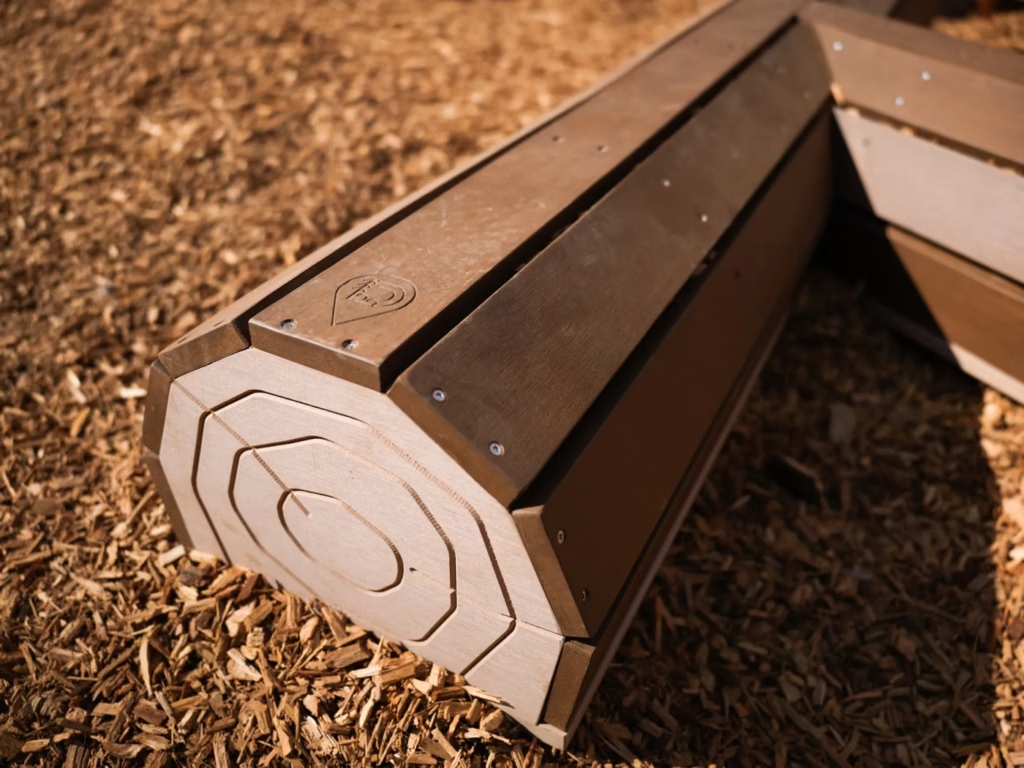
| ACRE (rice-hull PVC composite) | Real wood look and feel, resists water, rot, splintering and pests | Moves with temperature; nonstructural, so a frame carries the load | Routine inspection, a gentle wash at least every 6-12 months, no refinishing cycle for unfinished boards |
The logs-and-stumps guidance comes from the National Wildlife Federation’s ECHO guide to logs and stumps.
Older wooden playground equipment raises a fair question about chemicals. According to the U.S. Consumer Product Safety Commission’s Public Playground Safety Handbook, wood treated with chromated copper arsenate (CCA) has not been processed for playground use since December 31, 2003. For existing CCA wood, it cites data that a penetrating sealant or stain applied at least once a year can reduce arsenic migration. Creosote-treated wood, such as old railroad ties and telephone poles, should not be used.
Splinters are another common complaint from parents, and ACRE is made to resist splintering.
How GameTime Uses ACRE in Nature-Inspired Play
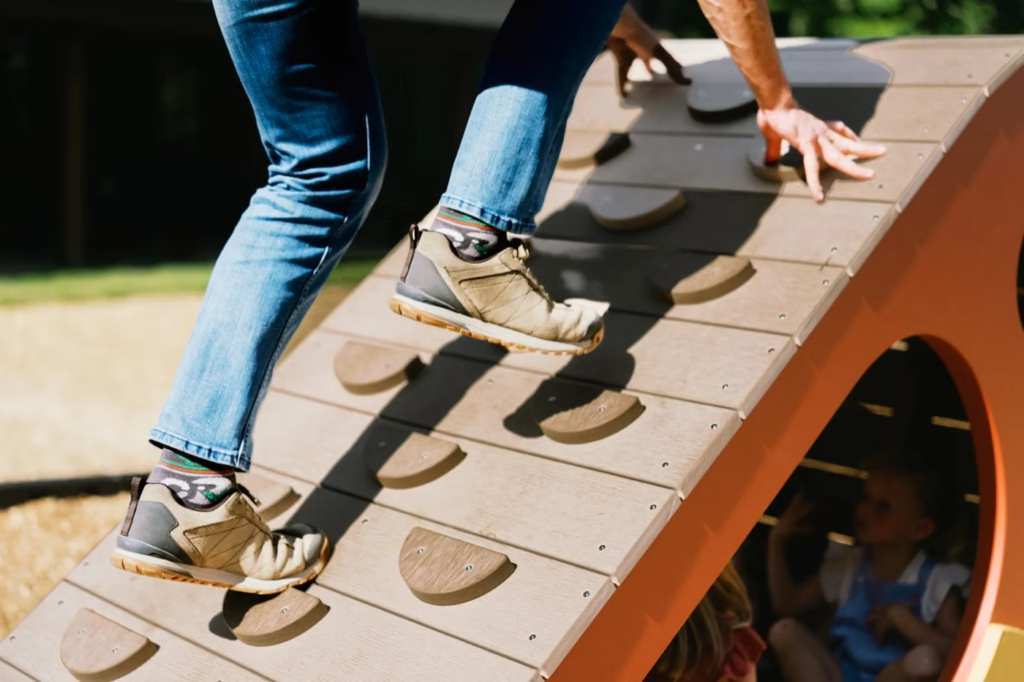
In September 2026 we partnered with GameTime, a PlayCore company founded in 1929, to bring ACRE to playgrounds nationwide. GameTime offers EverForms featuring ACRE for nature-inspired play, a series that includes freestanding climbers and character-inspired play pieces.
GameTime uses ACRE in play system barriers, decks and platforms and in sculptures such as bird and log forms. ACRE is a nonstructural material, so the frame of any play piece carries the load.
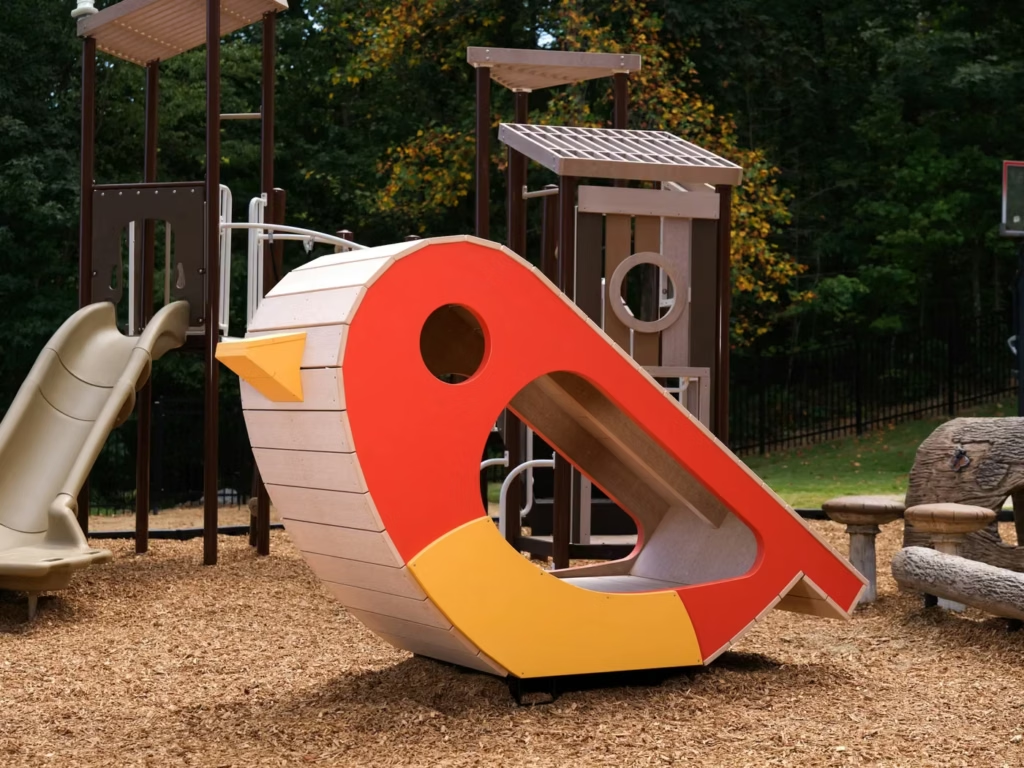
“At GameTime, we’re always looking for new ways to help communities create play spaces that feel connected to the places around them,” said Spencer Cheak, President, GameTime. “Our partnership with Modern Mill gives designers an entirely new material to work with. ACRE has the natural character people want in nature-inspired spaces, along with the durability and design flexibility a playground demands. And the fact that it begins with something as simple as a rice hull makes the story even better.”
“Modern Mill and GameTime are both in the business of creating spaces people enjoy,” said Chris Guimond, Founder and CEO of Modern Mill. “Now we’re working together to build spaces where kids can feel connected to nature on playgrounds across the country, interacting with a material that doesn’t come at nature’s expense.”
Rice hulls are the heart of our material: ACRE is a PVC composite made from over 50% upcycled rice hulls by volume, an agricultural byproduct, and we make it start to finish at our Mississippi mill without cutting down a tree. Read more on why rice hulls are gaining ground.
A few ACRE specs matter on a play site:
- Water: water absorption is under 1.0% in our technical data sheet, so rain and splash play don’t make it swell the way wood can.
- Color: use only water-based stains or 100% acrylic latex exterior paints, and never a color custom-tinted at a paint store. Our field coating requirements call for a Light Reflective Value (LRV) of 55 or greater, or a color from our approved lists, so ask us before going darker. On decking, use only the deck stain those requirements name.
- Heat: site ACRE pieces away from concentrated heat, such as sunlight reflected off Low-E windows on a nearby school building.
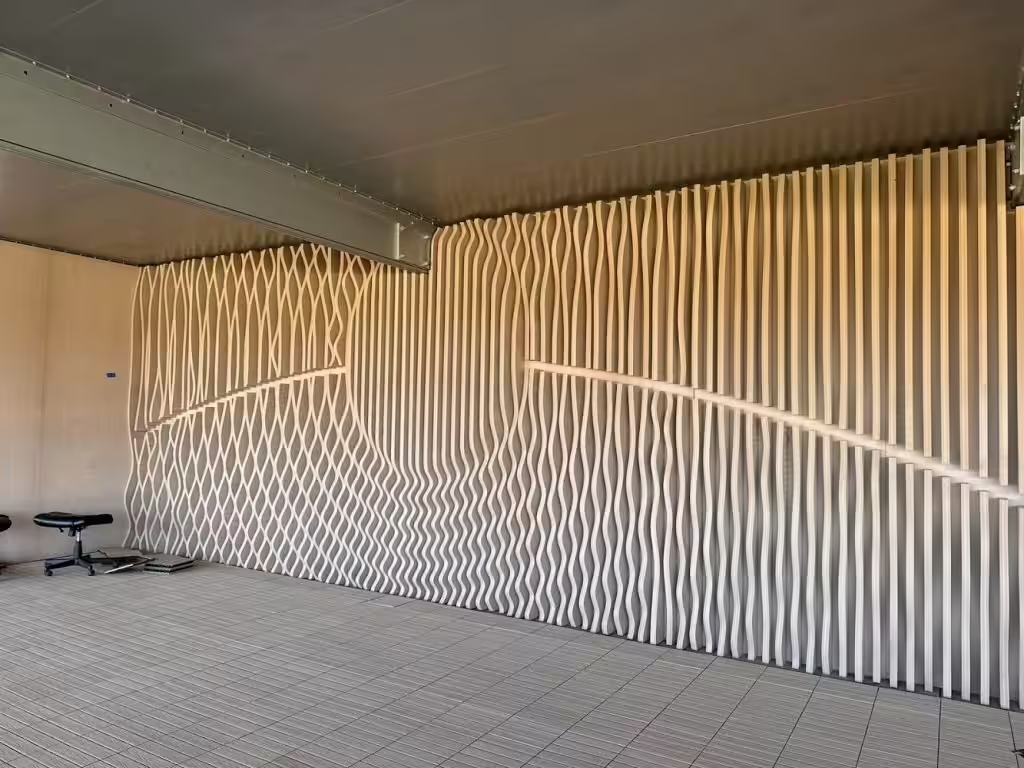
ACRE can also be thermoformed: heated and bent into curves like the wave wall below. Test a small piece first, as our Trim Installation Requirements advise.
Safety Rules Still Apply to Natural Elements
Treat a log as playground equipment once children climb on it. The CPSC handbook exempts only equipment children use with their feet on the ground, such as sand boxes, play houses and activity walls at ground level. Anything children climb onto or could fall from needs protective surfacing.
Grass and dirt don’t count as protective surfacing. Equipment without a more specific recommendation gets a use zone of at least 6 feet in all directions, and use zones should be free of obstacles, so keep boulders and logs out of a climber’s fall area. These are the minimum compressed loose-fill depths from Table 2 of the CPSC handbook:
| Loose-fill material | Depth | Protects to a fall height of |
|---|---|---|
| Shredded or recycled rubber | 6 in. | 10 ft |
| Sand | 9 in. | 4 ft |
| Pea gravel | 9 in. | 5 ft |
| Wood mulch (non-CCA) | 9 in. | 7 ft |
| Wood chips | 9 in. | 10 ft |
Loose fill other than rubber compresses at least 25% over time, so the handbook’s example is to install 12 inches of wood chips to keep 9. It also says loose fill should be avoided for playgrounds intended for toddlers; surfaces tested to ASTM F1292, including unitary surfaces, are on its appropriate list.
Logs used as balance beams have height limits: the CPSC handbook recommends no higher than 12 inches for preschoolers and 16 inches for school-age children, and doesn’t recommend balance beams for toddlers. Gaps between stacked logs, stumps or boulders matter too, since openings between 3.5 and 9 inches can trap a child’s head.
Public playground equipment is covered by ASTM F1487, and childcare facilities can refer to ASTM F2373 for children 6 through 23 months.
Accessibility applies to natural features as well. The U.S. Access Board’s guide to play areas explains that play components may be manufactured or natural, and that at least one of each type of ground-level play component must be on an accessible route, along with at least half of the play area’s elevated components. Ground surfaces along those routes must meet ASTM F1951. Engineered wood fiber and rubber tiles can meet both F1951 and the F1292 impact standard, though engineered wood fiber needs frequent upkeep to stay compliant.
Planning and Upkeep
Natural elements change with the seasons, so plan the upkeep alongside the build:
- Bring the right people in early. Maintenance staff and your risk manager belong at the first meeting, alongside teachers and the children who will use the space.
- Read the site. Map sun, shade, existing trees and where water collects. The handbook calls good drainage essential, because standing water breaks down loose-fill surfacing.
- Zone by age. The handbook separates toddlers (6 to 23 months), preschoolers (2 to 5 years) and school-age children (5 to 12 years).
- Draw the accessible route first, then place logs, boulders and planting along it.
- Write the upkeep plan before opening. Mark equipment supports with the minimum fill level, schedule surfacing top-ups, and budget to replace logs as they decay.
A phased build also works well: start with loose parts and a few logs, or a nature zone on an existing playground, then add trees, landforms and manufactured pieces as funding comes in.
Backyard Nature Play on a Budget
Most natural playground ideas scale down well, and a backyard version costs little. Ask a local tree service for hardwood rounds, set them firmly and keep them low. A dig patch, a mud kitchen and a basket of loose parts cover most of the play.
Skip logs with mushrooms or fungi growing on them. Cover any sand area at night so cats don’t use it. Keep small loose parts away from toddlers, who still put things in their mouths. Put protective surfacing, not grass or dirt, under anything a child can climb, and choose a manufactured swing set or climber that meets ASTM F1148, the home playground standard.
Frequently Asked Questions
How Much Does a Natural Playground Cost?
For parks and schools there is no standard price. Cost depends on grading and drainage, protective and accessible surfacing, how many manufactured pieces you add, and design fees. Ask designers for a phased estimate. A backyard version can cost little more than labor.
What Is the Least Toxic Playground Surface?
The CPSC handbook doesn’t rank surfaces by toxicity, but it rules out mulch made from CCA-treated wood and says to avoid mulch whose CCA content is unknown. Wood chips, non-CCA wood mulch, sand and pea gravel are the natural options on its list.
Why Did Playgrounds Stop Using Sand?
Sand is on the CPSC list of protective surfacing, but Table 2 shows it protects a lower fall height than wood chips, so sand works best in dig areas, with other surfacing under taller climbers.
Bring ACRE to Your Next Play Space
Specifying nature-inspired play? GameTime’s EverForms line brings ACRE to the equipment itself. For samples, spec sheets or a material question from your design team, contact our team.
Sources
- Dankiw et al., “The impacts of unstructured nature play on health in early childhood development: A systematic review,” PLOS ONE, 2020
- University of Tennessee at Knoxville, natural playground study release (ScienceDaily), October 11, 2012
- National Wildlife Federation, ECHO How-To Guide: Logs and Stumps
- U.S. Consumer Product Safety Commission, Public Playground Safety Handbook (Pub. 325)
- U.S. Access Board, Guide to the ADA Accessibility Standards, Chapter 10: Play Areas
- GameTime, EverForms featuring ACRE
- ACRE Technical Data Sheet, Field Coating Requirements, Care and Cleaning guide, fact sheets, Trim Installation Requirements and Three-Part Specification

Ready to Experience the
Difference?
Ask for ACRE at your local lumber yard or order samples to see for yourself why builders are making the switch.