ACRE Composite Cedar Shingle Siding: The Stainable Cedar-Shingle Alternative
September 2026Composite cedar shingle siding gives you the shingled-cedar look without the restaining, graying, and rot that come with real wood. Modern Mill's new ACRE Perfection Shingle is a fresh option in that category, and it does one thing most composites cannot: it takes stain and paint. Below are the specs, the install details, and how it compares to both real cedar and other composites.
What Is ACRE Composite Cedar Shingle Siding?
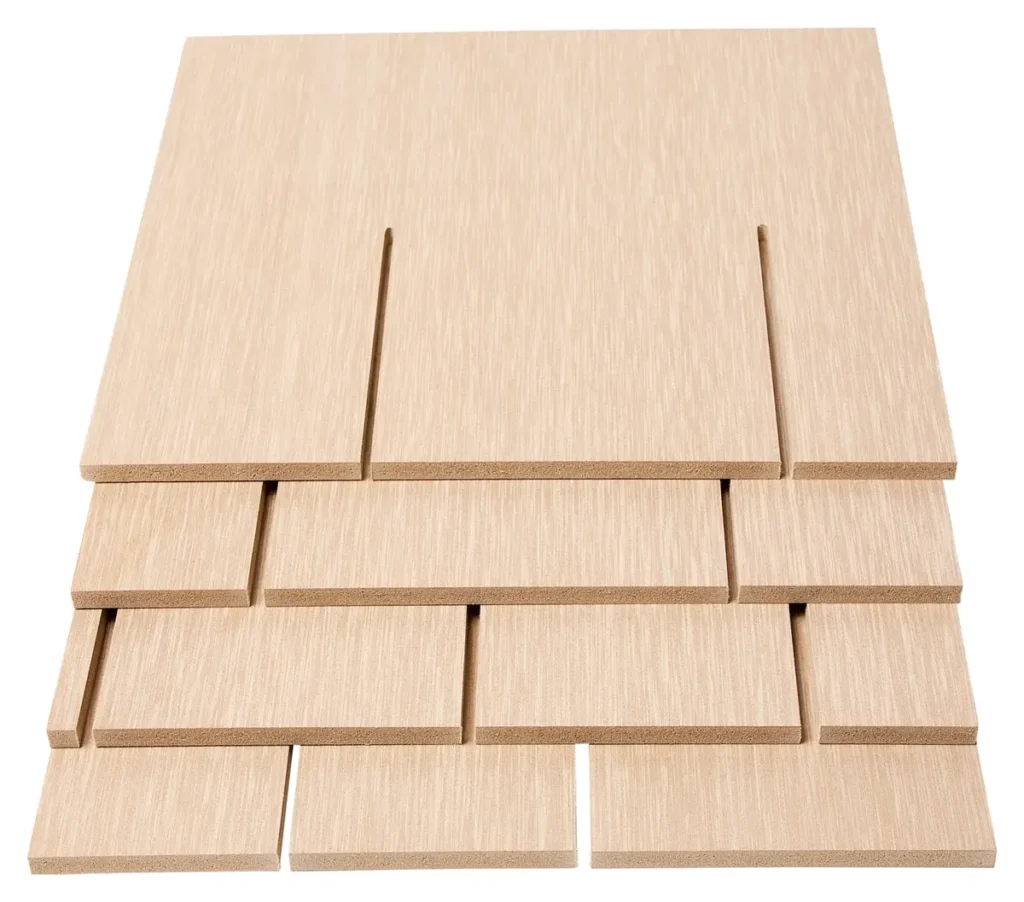
ACRE Composite Cedar Shingle Siding is Modern Mill's take on the cedar-shingle look, built to skip the sealing and restaining that real cedar demands. The Perfection Shingle is the newest profile in the ACRE line, and it reproduces a full course of sawn cedar shingles in a single board. If you are cross-shopping cedar shakes, note the difference: shakes are split, thick, and rough, while this profile gives the cleaner, sawn shingle look.
What sets it apart starts with the material. ACRE is extruded from upcycled rice hulls, a byproduct of rice milling, which makes it tree-free and gives it a natural grain rather than a molded plastic texture. It contains PVC as a binder, so it resists water, rot, and pests the way a wood-plastic composite does, while still cutting and fastening like softwood.
That mix is unusual. Most composite shake and shingle siding is fiber cement, engineered wood, or rigid PVC and polymer. ACRE's rice-hull composite is a different animal, and it is the reason the board takes stain and paint the way the others do not. The Perfection Shingle name itself comes from the traditional 18-inch cedar shingle it echoes, a type cataloged by the Cedar Shake & Shingle Bureau. If you want the background on how the material is made and where it fits, Modern Mill lays it out on its why ACRE page.
The Cedar-Shingle Look, Without the Upkeep
Cedar earned its place on American homes for good reasons. The grain and shadow lines of a shingled wall have a warmth no flat panel matches, and natural cedar insulates well and works easily under hand tools. A damaged shingle can also be pulled and replaced without touching the rest of the wall. Those are real advantages, and they are why cedar shake and shingle siding is still specified on custom and historic homes. It is a minority look today: vinyl, stucco, and fiber cement now lead new-home siding, per NAHB's 2025 materials data.
The trade-off shows up after the install. Cedar is a finish-maintenance material. The Western Red Cedar Lumber Association's own finishing guidance puts a semi-transparent stain at one to three years on smooth cedar and two to four on textured, with even paint topping out around ten to twelve years before it needs redoing. Skip that cycle and cedar grays and needs regular cleaning, and in wet spots it can rot, split, or draw carpenter bees and woodpeckers. Keeping it looking new means ongoing cedar siding maintenance, not a one-time job.
That gap between the look people want and the upkeep they do not is the whole reason composite exists. If you like the profile of cedar shake and shingle siding but do not want to be on a ladder with a brush every few summers, a composite shingle keeps the look and drops the restaining.
ACRE Perfection Shingle: The Specs
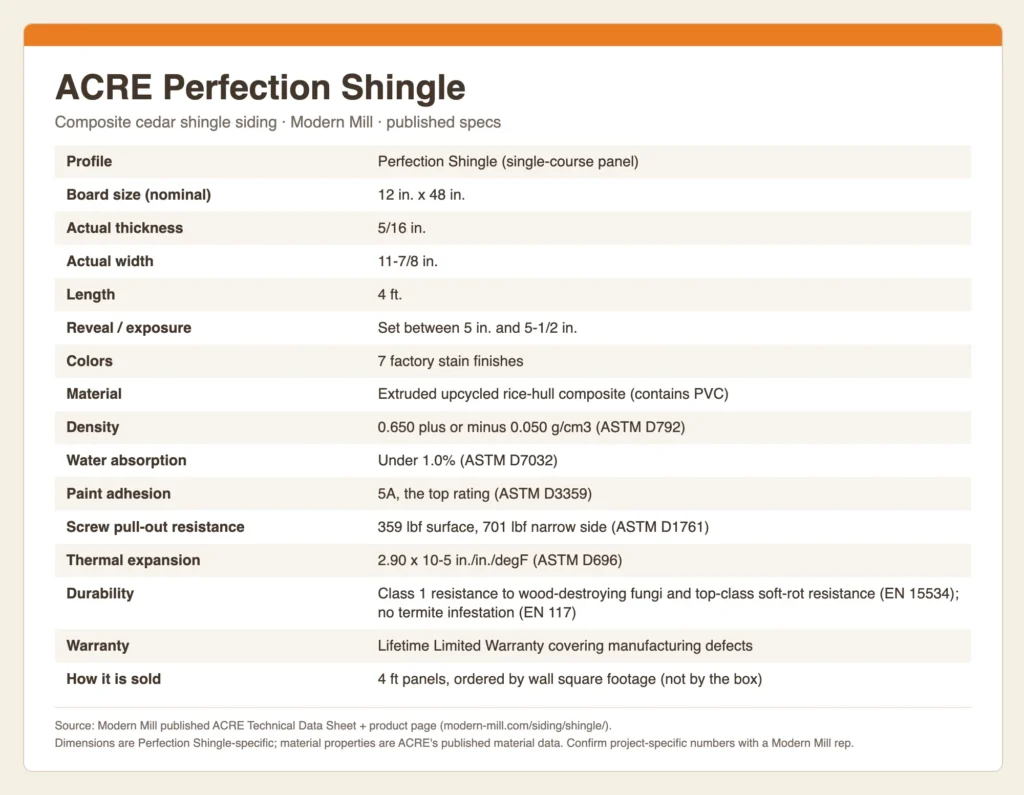
Most composite shake and shingle pages sell a look and stop there. Here are the actual numbers, drawn from Modern Mill's published Technical Data Sheet and product page, so you can spec the ACRE Perfection Shingle against anything else on your shortlist.
| Spec | ACRE Perfection Shingle |
|---|---|
| Profile | Perfection Shingle (single-course panel) |
| Board size (nominal) | 12 in. x 48 in. |
| Actual thickness | 5/16 in. |
| Actual width | 11-7/8 in. |
| Length | 4 ft. |
| Reveal / exposure | Set between 5 in. and 5-1/2 in. |
| Colors | 7 factory stain finishes |
| Material | Extruded upcycled rice-hull composite (contains PVC) |
| Density | 0.650 plus or minus 0.050 g/cm3 (ASTM D792) |
| Water absorption | Under 1.0% (ASTM D7032) |
| Paint adhesion | 5A, the top rating (ASTM D3359) |
| Screw pull-out resistance | 359 lbf surface, 701 lbf narrow side (ASTM D1761) |
| Thermal expansion | 2.90 x 10⁻⁵ in./in./degF (ASTM D696) |
| Durability | Class 1 resistance to wood-destroying fungi and top-class soft-rot resistance (EN 15534); no termite infestation (EN 117) |
| Warranty | Lifetime Limited Warranty covering manufacturing defects |
| How it is sold | 4 ft panels, ordered by wall square footage (not by the box) |
The board dimensions are specific to the Perfection Shingle. The material properties come from Modern Mill's published ACRE Technical Data Sheet, which covers the composite itself, so confirm any project-specific numbers with a Modern Mill rep. A couple are worth reading twice. Water absorption under one percent is a big reason the board resists swelling, and the paint-adhesion result of 5A, the highest rating on the ASTM D3359 scale, is the number behind the stainable claim below. The lifetime warranty covers manufacturing defects such as rot and splintering, not ordinary weathering, which is the plain way to read any siding warranty.
What Sets ACRE Apart From Other Composite Shingle Siding
Three things separate ACRE from the rest of the composite shingle field.
The first is that it takes stain and paint. Most composite shake and shingle siding arrives pre-colored, molded in a fixed palette, and cannot be refinished the way wood can. ACRE is different: it accepts a water-based stain or paint with no primer, backed by that top 5A adhesion rating, so you can match a color scheme now or change it years later.
The coating rule that comes with that is a warranty rule, and it is about heat, not looks. A stain or paint you apply in the field should be water-based with a light reflectance value (LRV) of 55 or greater, because a darker coating makes the board absorb more heat and move more. Modern Mill's factory finishes, including the darker tones like ACRE Black, are applied and warranted by Modern Mill as complete systems, so they are covered; matching one of those dark colors with your own field coating still needs rep approval. Either way, darker walls move more, which the install section covers.
The second is how it handles on the job. ACRE cuts with standard woodworking tools and a fine-tooth blade, so crews do not need the special saws or silica-dust precautions that fiber cement calls for, and it does not melt or turn brittle at the blade the way some polymers do.
The third is the material story. The rice hulls are an upcycled agricultural byproduct, which makes ACRE tree-free and keeps an ag waste stream out of the landfill while reducing demand for virgin wood. It is not a plastic-free product, since PVC is part of the composite. For sustainability-minded specs, the tree-free, upcycled-input story is a real point in its favor, PVC and all.
Colors and Finishes
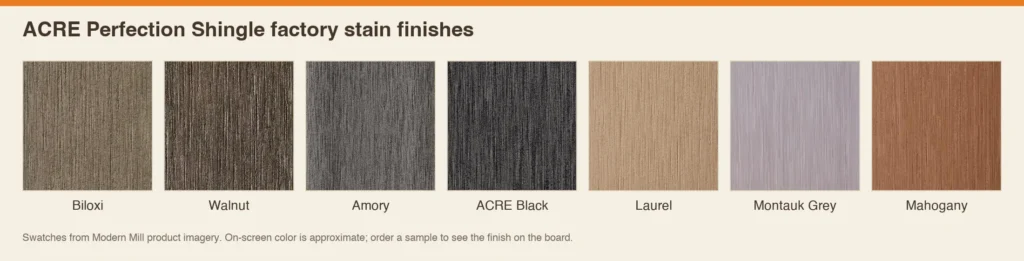
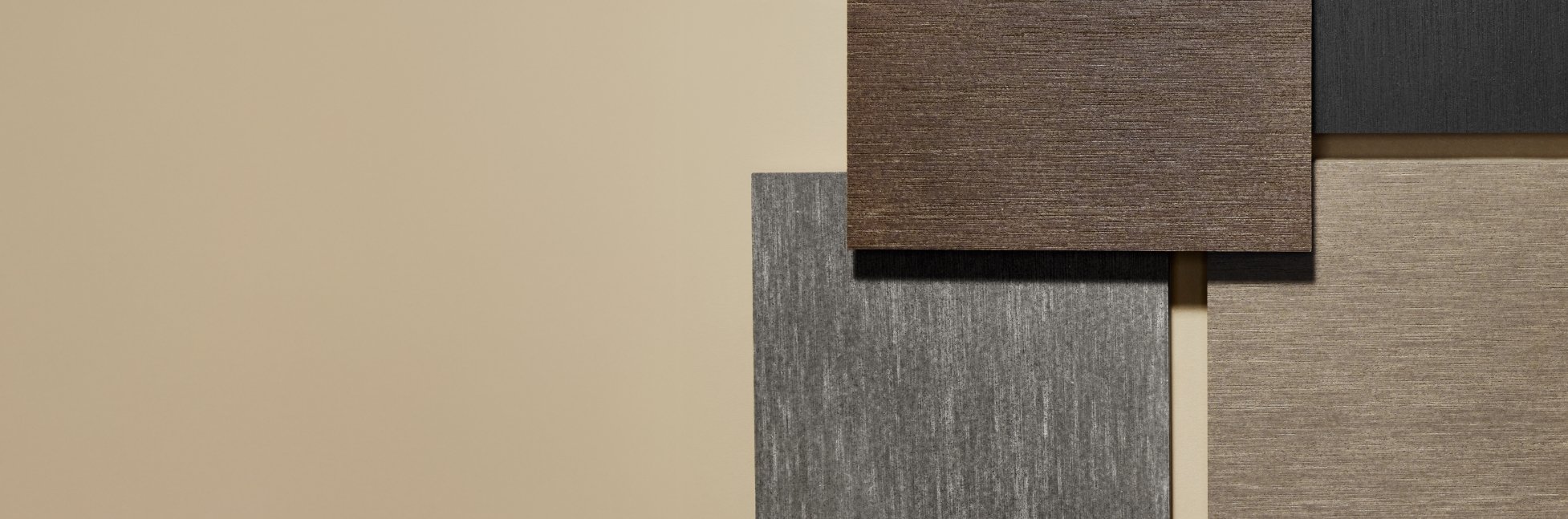
ACRE Perfection Shingle ships in seven factory stain finishes: Biloxi, Walnut, Amory, ACRE Black, Laurel, Montauk Grey, and Mahogany. Because the boards arrive finished, there is no jobsite sealing step before the wall is weather-ready.
Rice hulls vary slightly in color the way wood grain does, so some tone-to-tone variation from board to board is normal and expected. Modern Mill recommends pulling boards from several pallets as you go for the most even layout, the same trick installers use with natural cedar.
Over years of sun exposure, any exterior finish shifts, and ACRE is no exception. The difference is what it takes to refresh it. Where cedar needs stripping and recoating on a set cycle, ACRE can simply be re-stained or repainted when you want a change, within the LRV field-coating rule covered above. Owning it comes with no built-in restaining schedule.
How It Installs
The panel format is where the labor savings show up. Each board carries a full course of shingle faces, so one placement does the work of setting many individual shingles. That is the main reason a composite shingle wall goes up faster than a hand-nailed cedar one.
The fastening is straightforward for anyone who has hung siding. ACRE goes over a minimum 7/16-inch OSB or 1/2-inch plywood sheathing, and Modern Mill strongly recommends a draining or vented weather-resistive barrier behind it, because water can still reach the wall behind any cladding. Fasten with a minimum 8d by 2-1/2-inch ring-shank nail (0.099-inch diameter or larger) or a #8 by 2-1/2-inch screw, driven at least 1-1/4 inches into solid framing. Skip brads, finish nails, and staples. Set the reveal between 5 and 5-1/2 inches, the same range traditional cedar shingles use, and cut with the same woodworking tools already on the truck.
The one detail that trips up crews new to composites is thermal movement. ACRE expands and contracts with temperature, so Modern Mill sets the end gap by the temperature at install:
| Install temperature | End gap |
|---|---|
| 70 degF | 1/16 in. |
| Above 70 degF | No gap |
For installs below 70 degrees, follow the gapping in Modern Mill's installation guide rather than assuming the 70-degree figure, since a cooler board will expand more later. Lighter colors and shorter boards move less, which is worth planning around on a hot, dark wall. The full fastener schedule, corner details, and accessory list live in Modern Mill's own installation guides, which are the document to follow on any real job.
ACRE vs Real Cedar vs Other Composites
Each material has a case, and the right pick depends on what you are optimizing for.
| Factor | Real cedar shake/shingle | Typical composite shake/shingle | ACRE Perfection Shingle |
|---|---|---|---|
| Look | Most authentic grain and natural aging | Convincing molded texture | Natural rice-hull grain, stainable to match |
| Maintenance | Clean and recoat on a cycle | Occasional wash | Occasional wash |
| Refinishing | Sands and refinishes freely | Usually locked to factory color | Takes water-based stain or paint, no primer |
| Material | Renewable wood | Fiber cement, PVC, or engineered wood | Upcycled rice-hull composite (contains PVC), tree-free |
| Install | Course by course | Panelized | Panelized, cuts with woodworking tools |
| Durability | Depends on upkeep | High, low maintenance | Class 1 rot and fungi resistance, low water absorption |
Real cedar still wins on pure authenticity and the freedom to refinish, and it belongs on projects where a historic board requires it. Standard composites win on low upkeep but give up the ability to change color. ACRE's edge is that it keeps the low-maintenance side while staying refinishable, and it does it with a recycled-input material.
If you are weighing options, Modern Mill covers the field in its guide to alternatives to cedar siding, and there is a closer look at how the material stacks up against ACRE versus fiber cement for anyone cross-shopping composite cedar shake siding or deciding between them.
Cost and How to Get It
Composite shingle siding usually costs more up front than builder-grade cladding, and specialty profiles like a cedar-look shingle sit toward the higher end because fewer manufacturers make them. What changes the math is what you do not spend later. There is no required restaining cycle, so the recurring maintenance cost that comes with real cedar drops sharply.
ACRE ships as 4-foot panels and is ordered by the square footage of wall you are covering, not by the box, so take off your wall area and work from the sizes on the product page. Pricing is set by distributors and dealers rather than published as a flat rate, so the plain answer to what it costs is to get a quote for your project and your region. What you are paying for is the durability in the spec table, the low water absorption and Class 1 rot resistance, plus a Lifetime Limited Warranty that backs the board against manufacturing defects. Expect it to sit above builder-grade cladding and in the range of other premium composites.
The low-risk way to start is to see and feel the board yourself. Modern Mill lets you order a $5 sample so you can check the grain, the finish, and how it takes a stain before you commit a whole wall to it.
Frequently Asked Questions
How does composite cedar shingle siding compare to real cedar?
It keeps the cedar-shingle look while dropping the finish-maintenance cycle. Real cedar needs recoating every few years, grays if you skip it, and can rot or draw insects in wet spots. A composite like ACRE resists water, rot, and pests and only needs an occasional wash, though cedar still holds the edge on pure authenticity and the freedom to refinish raw wood.
Can you stain or paint composite shingle siding?
Most composite shingle siding is pre-colored and cannot be refinished, which is what makes ACRE unusual. It accepts a water-based stain or paint with no primer, backed by a 5A rating on the ASTM D3359 adhesion scale. Any finish you apply in the field should have a light reflectance value of 55 or greater to keep the board from absorbing too much heat, while Modern Mill's factory stains already account for that, and matching a darker color on your own needs rep approval.
How long does composite cedar shingle siding last?
Composite siding is built to outlast the restaining cycle that limits unmaintained cedar. ACRE has no published year count; its durability comes from the specs, the low water absorption and Class 1 resistance to rot and fungi, and a Lifetime Limited Warranty backs the board against manufacturing defects.
How is ACRE shingle siding installed?
It installs as a panel system, with each board covering a full course of shingle faces over a minimum 7/16-inch OSB or 1/2-inch plywood sheathing and the draining or vented weather-resistive barrier Modern Mill recommends. Fasten with a minimum 8d ring-shank nail or a #8 screw driven at least 1-1/4 inches into solid framing, and leave the temperature-based end gap the guide specifies. Always follow Modern Mill's published installation guide for the full detail.
Does composite cedar shingle siding look fake?
The "looks fake" problem usually comes from a repeating molded pattern and a locked factory color. ACRE avoids both: the rice-hull composite carries a natural grain rather than a molded one, and because it takes stain, you can tune the color to look like weathered or fresh cedar instead of a factory tone. Seeing a sample in daylight is the fastest way to judge it for yourself.
What goes under composite shingle siding?
ACRE installs over a minimum 7/16-inch OSB or 1/2-inch plywood sheathing with a draining or vented weather-resistive barrier behind the panels. That drainage layer matters because water can still reach the wall behind any siding, composite included. Furring for a rainscreen is supported and spelled out in the installation guide.
The Bottom Line
If the appeal of cedar shingles is the look and the drawback is the upkeep, a composite shingle is the way to keep one and lose the other. ACRE Perfection Shingle goes a step further than most composites by staying refinishable and pairing a rice-hull, tree-free material with real, published specs you can hold anyone else's product to.
The best next step is a small one. Order an ACRE sample from Modern Mill, stain a piece if you want to test the finish, and see how it reads on your own wall before you price out a full elevation. For a spec-heavy product, a board in hand answers more questions than any brochure.
Ready to Experience the
Difference?
Ask for ACRE at your local lumber yard or order samples to see for yourself why builders are making the switch.