Types of Siding: 9 House Siding Materials Compared
September 2025The main types of siding are vinyl, fiber cement, wood, engineered wood, composite and PVC, metal, stucco, brick veneer and stone veneer. Each one differs in how it protects the house, what it costs and how much maintenance it asks for.
Choosing house siding is really two decisions. The material sets most of the maintenance, fire performance and cost. The profile, meaning the shape of the boards, sets much of the look. Settle the material first, then the profile, and the quotes get much easier to compare.
Types of Siding at a Glance
Between them, these house siding options cover nearly every exterior in the US. They differ most in what they’re made of, relative installed cost, routine maintenance and fire behavior.
| Siding type | Made of | Relative installed cost | Routine upkeep | Fire behavior |
|---|---|---|---|---|
| Vinyl | PVC panels, sometimes foam-backed (insulated vinyl) | Low | Wash; no painting | Softens and melts in high heat, and can burn |
| Fiber cement | Typically portland cement, sand and cellulose fiber | Moderate | Repaint over time; maintain joint details | Non-combustible |
| Wood | Cedar, redwood, pine and other species | Moderate to high | Paint or stain on a cycle; watch for rot | Combustible |
| Engineered wood | Wood strands or fibers bonded with resins, factory primed or finished | Low to moderate | Repaint over time; keep cut edges sealed | Combustible |
| Composite and PVC | Cellular PVC, polymer-mineral blends, or plant fiber such as rice hulls bonded with PVC | Moderate to high | Wash; coated boards follow the coating maker’s recoat schedule (varies by product) | Combustible; flame spread ratings and wildfire listings vary by product |
| Metal | Steel or aluminum with a factory finish | Moderate | Wash; touch up scratches | Non-combustible (aluminum can melt in intense heat) |
| Stucco and EIFS | Cement plaster over lath, or foam board with a synthetic finish coat (EIFS) | Moderate | Repair cracks; keep drainage clear | Cement stucco is non-combustible; EIFS has a foam core, so ratings depend on the system |
| Brick veneer | A single layer of brick tied to the wall over an air space | High | Repoint mortar over decades | Non-combustible |
| Stone veneer | Natural stone, or manufactured stone cast from concrete | High (manufactured) to highest (natural) | Repair mortar joints; keep drainage details intact | Non-combustible |
Relative cost is a typical ranking, not a quote. Local labor rates, the product line and your wall’s condition can move any material up or down a tier.
You won’t find a lifespan column here, on purpose. Published lifespans for the same material disagree by decades, because climate, installation quality and maintenance decide how long siding lasts more than the material name does. Our guide to long-lasting siding options goes deeper on durability.
What Counts as Siding?
Siding is the outer covering of a house’s exterior walls. Builders also call it cladding or the exterior wall covering. It sets the look of the house and takes the sun, wind and rain first.
Siding sheds most of the water, but it isn’t the waterproof layer. The 2024 International Residential Code requires a water-resistive barrier behind the exterior cladding, plus a way for water that gets past the cladding to drain back out.
That’s why flashing, house wrap and the condition of the sheathing matter as much as the material you choose. Siding on typical framed walls relies on them. It’s also why you should clean siding with a soft brush and a gentle spray, and never aim a pressure washer into the joints.
The Main Types of Siding Materials
Vinyl Siding
Vinyl siding is made from PVC and installs as long interlocking panels. It’s the budget leader among mainstream materials, it never needs painting, and it comes in a wide range of colors and profiles, from traditional lap to Dutch lap, board and batten and shake-style panels.
Insulated vinyl adds a rigid foam backing behind the panel, which stiffens it and adds some insulation. The building code treats it as its own product category, with its own standard (ASTM D7793).
Thin panels can crack when something hits them, especially in cold weather, and a cracked panel usually has to be replaced rather than repaired.
Concentrated heat can also distort it. The Polymeric Exterior Products Association, the trade group for vinyl and other polymeric siding, explains that sunlight concentrated by some windows, including energy-efficient low-E glass, can distort polymeric siding. It also notes those temperatures are not routinely reached, and that landscaping, sunshades or window screens can reduce or eliminate the problem.
Vinyl makes the most sense when budget leads the decision; compare its texture, seams and shadow lines in person against other wood-look products. Our guide to alternatives to vinyl siding compares the options.
Fiber Cement Siding
Fiber cement siding is typically a blend of portland cement, sand and cellulose fiber, formed into planks, panels and shingles. It doesn’t burn, it shrugs off rot and insects, and it holds paint well. Embossed grain gives it a convincing painted-wood look from the street.
Weight is the main drawback. Boards are heavy and need careful handling, so installation takes more labor than vinyl.
Cutting it also creates crystalline silica dust. OSHA’s construction silica standard lists handheld saws cutting fiber-cement board among the tasks that require dust controls, such as a saw with a dust collection system. Anyone cutting it, crew or DIYer, needs that kind of dust control, which is a good reason to leave fiber cement to a pro.
Fiber cement still needs paint. Factory finishes tend to last longer than field paint, and when the coating eventually wears, the boards need repainting. Joints and cut edges need the treatment the manufacturer specifies, such as caulk, flashing or joint covers, so water doesn’t get in.
Wood Siding
Wood siding is the original, and still the benchmark the other materials imitate. Cedar, redwood, pine and other species come as clapboards, shingles, shakes and board and batten. Wood can be stained to show the grain or painted any color, damaged boards can be swapped one at a time, and in historic districts it’s often the expected choice.
Wood asks for regular upkeep. Paint and stain wear on a cycle, and wood left with a failing finish, or kept wet where water sits, can rot and draw insects. Cedar siding’s heartwood contains natural compounds that help it resist decay, and left unfinished it weathers to a silver-gray that many owners choose on purpose.
Wood is also combustible, which matters in wildfire-prone areas. Cedar shakes and shingles, in particular, have lower-maintenance look-alikes in several of the materials in this guide.
Engineered Wood Siding
Engineered wood siding is made from wood strands or fibers bonded with resins and waxes, then sold primed or prefinished. It’s generally lighter than fiber cement, it comes in long boards with a wood-grain face, and it usually costs less than solid wood.
Manufacturers’ installation instructions typically call for sealing or painting cut ends and keeping the finish intact, because the wood fiber inside can swell where water gets in.
Installed and maintained to those instructions, engineered wood gives a wood look at a moderate price. It’s still a wood product, so it’s combustible.
Composite and PVC Siding
Composite siding covers manufactured boards that aim for the look of wood with less upkeep. It’s also the loosest label in the category: depending on who’s selling, it can mean engineered wood, cellular PVC boards (thick, solid boards of foamed PVC, unlike thin vinyl panels), polymer boards with mineral fillers, or boards made from a plant fiber bonded with a plastic. Ask what a product is actually made of before you compare it.
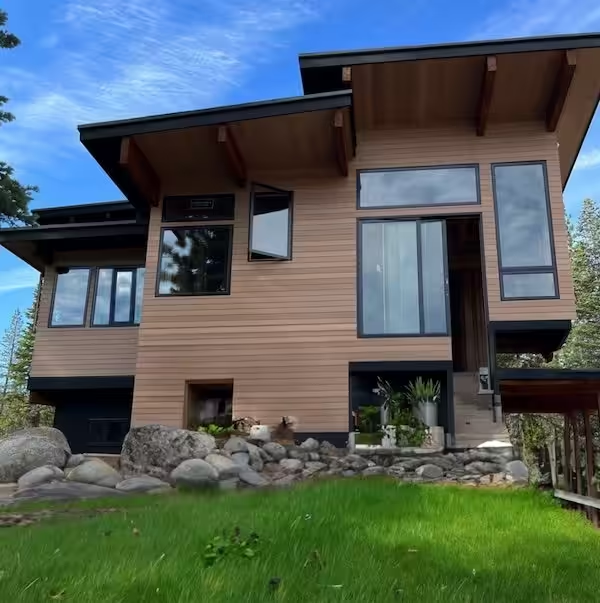
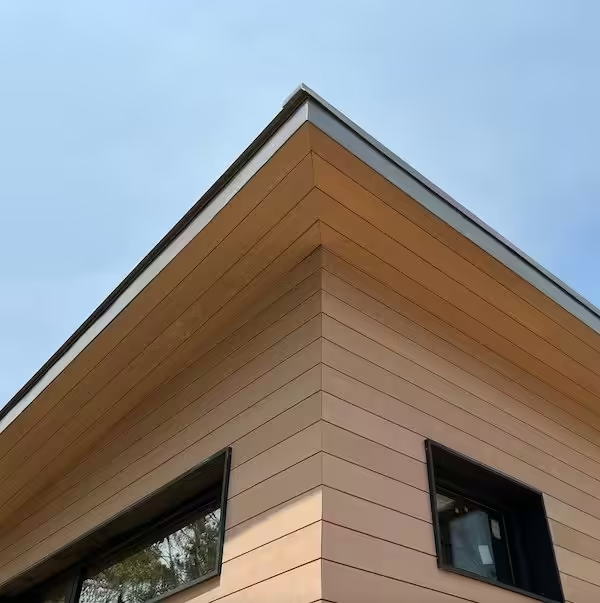
Our ACRE siding falls in the plant-fiber group. According to its California State Fire Marshal listing, ACRE Shiplap is 60% upcycled rice hulls and 40% PVC, and it’s made in Fernwood, Mississippi. Rice hulls give each board natural color variation, and the boards cut, rout, fasten and sand with standard woodworking tools. Using rice hulls instead of wood sets ACRE apart from wood-plastic decking boards and from engineered wood, which is mostly wood fiber, as our guide to what composite wood is explains.
ACRE’s technical data sheet, fact sheets, fire listing and EPD publish the numbers that matter for siding:
- Water absorption below 1.0% under ASTM D7032, and a uniform texture all the way through, so cut ends don’t need sealing
- An ASTM E84 flame spread index of 40, which falls in Class B
- A Wildland-Urban Interface listing with the California State Fire Marshal (BML 8140-2385:0001) for brown ACRE Shiplap in 1-inch-thick boards, valid only in the specific wall assembly that was tested and through June 30, 2027
- A third-party Environmental Product Declaration (SCS-EPD-08391, cradle-to-gate, valid through November 14, 2027), the kind of document worth asking any manufacturer for if embodied carbon matters to you
New ACRE boards take water-based stain or 100% acrylic latex paint with no primer, and multiple coats need the manufacturer’s approval. Because ACRE contains PVC, its coating requirements call for a light reflective value (LRV) of 55 or higher, or a color from Modern Mill’s approved lists with no custom tinting, to limit heat build-up.
Like any PVC-based board, ACRE moves with temperature, though its fact sheets rate that movement below competitive PVC, and the installation guides set the gaps for it. The window-reflected sunlight described under vinyl applies here too, and the fact sheets warn about it; the LRV rule limits the extra heat a dark color would add. ACRE generally doesn’t gray the way natural wood does, but strong UV can fade its color over the years; a UV-resistant stain or paint slows that, and recoats follow the coating maker’s schedule. ACRE siding comes in shiplap, nickel gap, V-groove, edge and center bead, board and batten, and shingle profiles, and every installation should follow the published installation guides.
Metal Siding
Metal siding comes in steel and aluminum panels with a factory-applied finish. It doesn’t burn, rot or attract insects, it needs little more than washing, and it can be recycled. Modern profiles include sleek vertical panels and wood-grain finishes, so it’s no longer just a barn or commercial look.
Aluminum dents more easily, and steel can rust where the coating gets scratched or cut and isn’t touched up.
Stucco and EIFS
Stucco is a cement plaster applied in coats over metal lath, finished as one seamless surface. It’s durable, it doesn’t burn, and the color can be mixed into the final coat. It’s also one of the most common exteriors on new homes, as the numbers below show.
EIFS, or exterior insulation and finish system, looks like stucco but works differently: foam insulation board covered with a reinforced base coat and a finish coat, which adds a layer of insulation outside the wall structure. Both systems depend on water management behind the surface. Under the 2024 IRC, EIFS without a drainage layer is limited to concrete or masonry walls, and EIFS with drainage is required over other wall assemblies. Cracks need prompt repair, because water that gets behind either finish has to be able to drain out.
Brick and Stone Veneer
Brick veneer on a modern house is a single layer of brick tied to the wall over an air space, not a structural wall. Stone veneer can be natural stone, either anchored like brick or adhered with mortar, or manufactured stone cast from concrete and adhered to the wall. Both are non-combustible, very durable and need little routine maintenance beyond mortar repairs over the decades. Adhered veneer, like stucco, depends on the water-resistive barrier and drainage behind it, and the IRC applies stucco’s barrier rules to it.
Veneer sits at the top of the price range and needs proper support, so many homes use it on one wall or as a wainscot base, with lighter siding above.
Siding Profiles: The Shape of the Boards
Once the material is settled, the profile decides much of the look. It’s the shape of each board and how the boards meet, and it’s what most people mean by siding styles. Most board siding either overlaps (lap and Dutch lap), covers its seams with battens (board and batten), or joins at the edges with a rabbet or a tongue and groove (shiplap, nickel gap and tongue and groove). Shingles, shakes and large panels round out the list.
| Profile | Runs | How the boards meet | Look |
|---|---|---|---|
| Lap (clapboard, bevel) | Horizontal | Each board overlaps the one below | Classic, with a strong shadow line |
| Dutch lap | Horizontal | Overlapping boards with a groove along the top edge | Deeper, softer shadow |
| Shiplap | Horizontal or vertical | Edges overlap or lock, leaving a consistent reveal | Clean, consistent lines, cottage to coastal |
| Nickel gap | Horizontal or vertical | Faces sit flush with a narrow, even gap | Tighter, more modern lines |
| Tongue and groove, V-groove | Horizontal or vertical | A tongue fits the next board’s groove; V-groove adds a chamfer at the joint | Tight, paneled |
| Board and batten | Vertical | Narrow battens cover the seams between wide boards | Farmhouse to modern |
| Shingles and shakes | Horizontal courses | Individual pieces overlap course by course | Textured, coastal or cottage |
| Vertical panels | Vertical | Large sheets, often grooved to look like boards (T1-11 is a common pattern) | Quick, simple coverage |
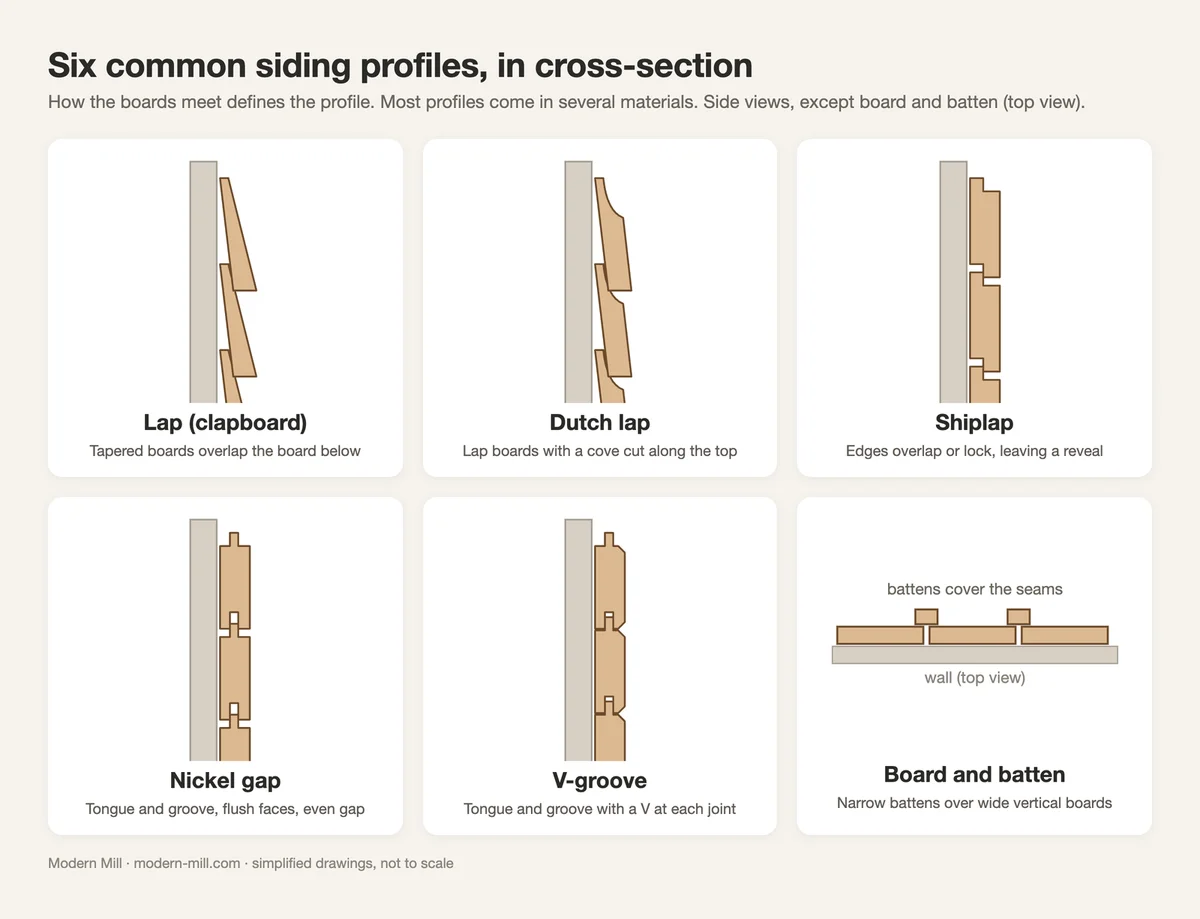
Most profiles come in more than one material. Shiplap can be solid wood or a manufactured board, and board and batten works in many of the materials on this list, as our board and batten sizing guide shows.
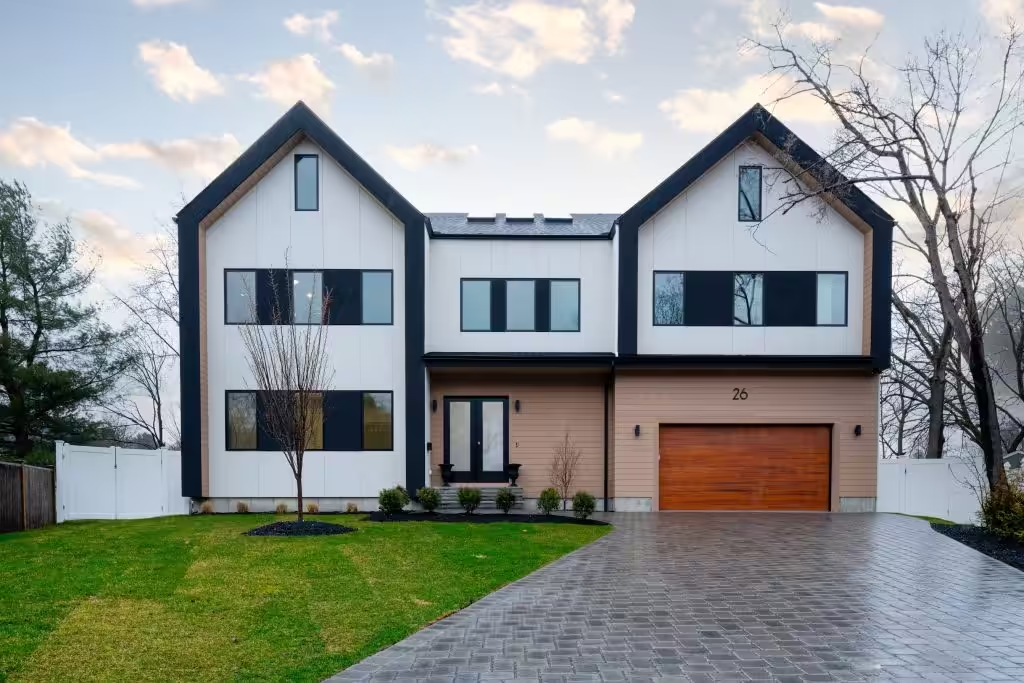
Our shiplap siding guide explains how shiplap differs from lap and clapboard. Many homes also mix directions, with vertical siding on gables or entries and horizontal siding elsewhere.
Which Type of Siding Is Most Common?
On new homes, vinyl and stucco are effectively tied. Of the new single-family houses completed in 2025, vinyl siding and stucco were each the primary exterior wall material on about 26%, according to the U.S. Census Bureau’s Characteristics of New Housing data.
Fiber cement followed at 23%, brick at 16% and wood at 6%. Everything else, including stone, concrete block and aluminum siding, came to about 2%.
The biggest trend on new homes is fiber cement. It rose from 9% in 2005, the first year the Census counted it separately, to 23% in 2025, while vinyl went from 34% to 26% over the same years.
Those figures describe new construction. Across the 123.5 million occupied US homes in the Energy Information Administration’s 2020 Residential Energy Consumption Survey, siding of any kind (aluminum, fiber cement, vinyl or steel, counted together) was the main wall material on 37%, brick on 27%, wood on 15% and stucco on 13%.
Matching Siding to Your Climate
Climate rarely rules a material out, but it changes which materials need extra care.
| Condition | Strong fits | Plan for |
|---|---|---|
| Wet or humid | Vinyl, fiber cement, composite and PVC, metal | Wood and engineered wood need an intact finish; in moist or marine climates, the IRC calls for added drainage behind stucco |
| Freezing winters | Most materials, with finishes and joints kept sound | Thin vinyl can crack on impact in the cold; fiber cement needs sound paint so water can’t soak in and freeze |
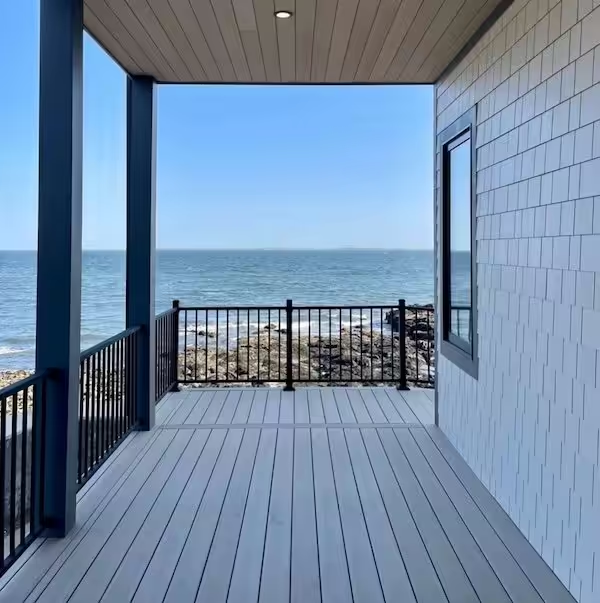
| Coastal salt air | Aluminum, fiber cement, composite and PVC | Steel needs its coating intact, or it can rust at scratches and cut edges |
| Hot and dry | Stucco, brick and stone veneer, metal | Light colors run cooler on PVC-based siding; reflected sunlight from some windows can distort polymeric siding |
| Wildfire-prone | Non-combustible materials and products listed for wildfire use | Local wildfire codes; wood, engineered wood, vinyl and composite siding are combustible |
Wildfire codes vary by state and county. In California, the 2025 California Wildland-Urban Interface Code took effect on January 1, 2026, and the State Fire Marshal’s listing program shows which products passed wildfire testing, and in what assembly.
Siding on Older Homes: What You Might Have
If you’re replacing house siding on an older home, start by identifying what’s there, and treat two hazards first. The EPA says you generally can’t tell whether a material contains asbestos by looking at it: leave suspect material undisturbed, don’t saw, sand, scrape or drill it, and have a trained, accredited professional take samples. Homes built before 1978 may also have lead-based paint: the EPA requires anyone paid to do work that disturbs paint in them to be certified in lead-safe work practices, unless a test by a trained professional shows lead-based paint isn’t present.
These materials show up often:
- Asbestos-cement shingles. The EPA lists roofing and siding shingles among the places asbestos may be found in homes.
- Aluminum or steel siding. Metal panels; aluminum dents easily.
- Hardboard lap siding. A dense board made from pressed wood fiber. Check the bottom edges and nail holes for swelling.
- Plywood panel siding. Large sheets with vertical grooves cut to look like boards, often called T1-11.
- Wood clapboards and shingles. Often hidden under later layers of paint or newer siding.
For the rest, look at an existing exposed edge in an inconspicuous spot, such as behind a downspout, without cutting anything. A magnet sticks to steel but not to aluminum.
Unless testing finds asbestos, plan to remove the old siding rather than cover it, so you can check the sheathing and water-resistive barrier before the new material goes on. If it does, removal is a job for an accredited asbestos professional, who can also tell you whether enclosing it in place is the safer option. If new windows are on your list, re-siding is the time to do them, since the siding around them comes off anyway.
Frequently Asked Questions
How Much Does It Cost to Side a House?
Wall area, the material and what’s found underneath drive the price. For a national benchmark, Zonda’s 2025 Cost vs. Value report prices a 1,250-square-foot siding replacement at $17,950 in vinyl with 97% of the cost recouped at resale, and $21,485 in fiber cement (114% recouped). Siding is priced by the square, meaning 100 square feet of wall, not by your home’s floor area, so measure wall height times length and subtract large openings. Get at least three quotes, and ask each one to list tear-off, sheathing repair, water-resistive barrier, trim and disposal separately.
What Siding Should You Avoid?
Avoid mismatches more than materials. Skip thin, builder-grade vinyl where impacts are likely in cold weather, combustible siding without a wildfire listing in a wildland-urban interface zone, and EIFS without drainage over a framed wall. Don’t cover suspected asbestos-cement or swollen hardboard without testing and inspection, and skip an installer who won’t follow the manufacturer’s instructions, which the IRC writes into its attachment rules.
What Is the Best Type of Siding for a House?
The best siding is the one that fits your priority. Vinyl usually has the lowest upfront cost. Fiber cement and composites like ACRE give a wood look and can cut the repainting and rot risk that come with real wood, though finish maintenance varies by product; engineered wood gives the look for less but still needs repainting. Vinyl and metal need little beyond washing, brick and stone veneer need mortar work only over decades, and in wildfire areas the field narrows to non-combustible materials and listed products. Weigh the different types of siding against that priority and your climate to reach a short list. Our siding buyer’s framework walks through the decision step by step.
See the Materials in Person
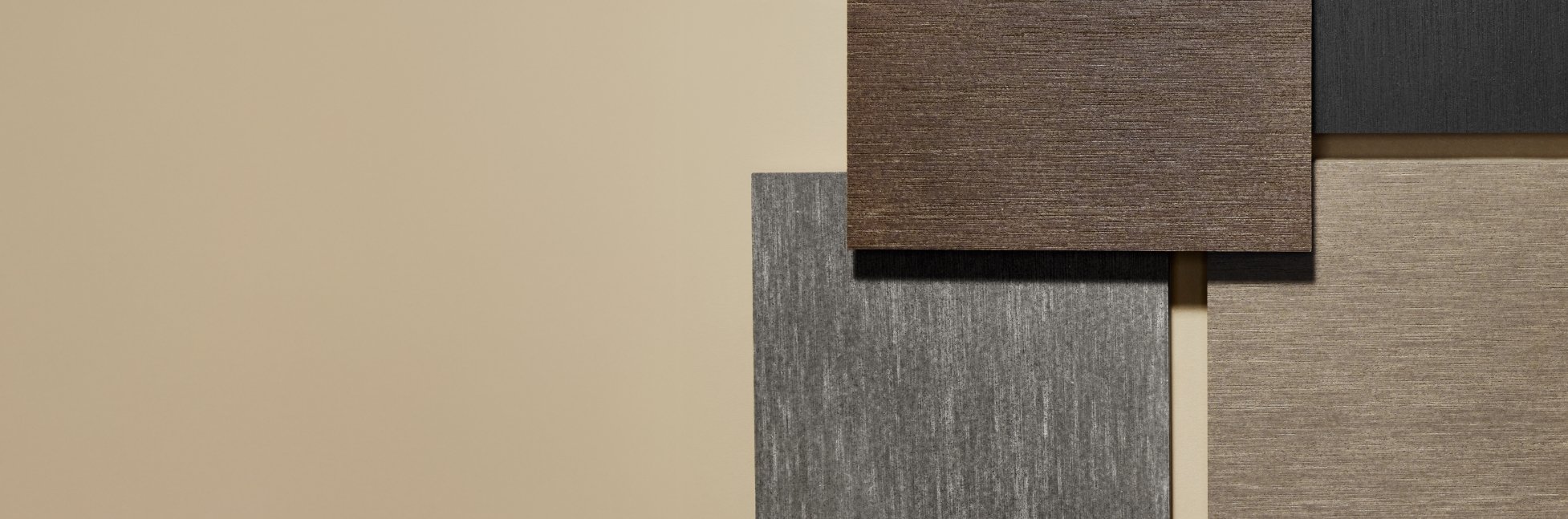
Photos only go so far with siding. Grain, texture and color variation read differently in your hands and in your own light. If ACRE is on your list, order ACRE samples from Modern Mill to set beside the other materials you’re comparing, or ask our team about profiles and coatings for your project.
Ready to Experience the
Difference?
Ask for ACRE at your local lumber yard or order samples to see for yourself why builders are making the switch.