Sustainable Cladding Materials for Architects: Bio-Based, Recycled & Waste-Derived Options Compared (2026)
September 2026Architects asking for sustainable cladding materials get the same answer from every manufacturer: ours. We make one of the materials on this list, so instead of pretending neutrality, this guide applies the same published criteria to every category: bio-based, recycled-content, and waste-derived. It scores each material on six factors including embodied carbon and end-of-life, maps the LEED v4.1 credit mechanics, and flags where the documentation gaps hide. The goal is a cladding spec you can defend to a skeptical client and a green building reviewer in the same meeting.
What Actually Makes a Cladding Material Sustainable?
Most "eco-friendly" cladding marketing answers a question nobody asked. The question that matters for a spec is narrower: what is this material made from, what did it cost the atmosphere to produce, how long will it stay on the wall, and where does it go when it comes off?
Sustainable cladding materials hold up across six criteria, not one:
- Feedstock origin. Virgin, recycled, grown, or waste stream. Each carries a different upstream footprint.
- Embodied carbon. Measured in kg CO2e per square meter of installed cladding, not per kilogram of material. A light, durable product can beat a "greener" heavy one once you normalize the units.
- Service life. A facade that lasts 50 years amortizes its footprint across decades. One replaced at year 15 pays its carbon bill twice.
- End-of-life pathway. Recyclable in theory is not recyclable in practice. What matters is whether a real recovery stream exists.
- Verified documentation. An environmental product declaration (EPD) or third-party label beats a brochure adjective every time.
- Material health. Whether the formulation contains chemicals that green building programs screen out.
Greenwashing usually hides in criteria 2 and 4. A vendor quotes carbon per kilogram for a lightweight product, or stamps "recyclable" on a board no facility on the continent actually accepts. When you compare environmental impact claims, hold the denominator constant and ask for the EPD modules behind the number.
One terminology note: in US residential work, exterior cladding and siding are the same wall layer; an architect's sustainable cladding search and a homeowner's eco-friendly siding search land on the same products. This guide uses both terms, since manufacturers publish data under both labels. We covered the design side of this conversation in our piece on sustainable materials for architects; this one is about the materials themselves.
There is also a real debate behind criterion 3. Some architects argue a high-carbon material that lasts a century beats a low-carbon one replaced twice. Others point out the carbon emitted today matters more than carbon amortized over 60 years. Both are right often enough that durability and embodied carbon need to be scored together, not traded one for the other.
Bio-Based, Recycled, or Waste-Derived: Know What You're Specifying
These three labels get used interchangeably across sustainable building materials marketing, and cladding is where they do the heaviest lifting. They describe different things, and the difference changes how a material scores.
Bio-based means the feedstock was grown: wood, bamboo, cork, plant fibers. The sustainability case rests on regrowth rates, responsible forestry, and the carbon the plant absorbed while growing.
Recycled-content means the feedstock already lived one life as a product: post-consumer aluminum, reprocessed steel, recycled polymers. The case rests on displacing virgin extraction.
Waste-derived means the feedstock is a byproduct that would otherwise be burned or landfilled: rice hulls from milling, sawdust, agricultural residues. The feedstock case is compelling, because the material consumes a waste stream without competing for crops, trees, or recycling-bin supply. One caution travels with the whole category: most waste-derived boards bind their filler in a polymer matrix, so score the full formulation, not the filler alone.
Why does the taxonomy matter? Because "carbon negative" on a label means the product stored more biogenic carbon than its manufacturing emitted, under one accounting method, at the factory gate. It does not mean your wall assembly is carbon negative once transport, fasteners, subframe, and finish enter the math. Biogenic carbon (the CO2 a plant absorbed while growing) only stays stored as long as the product stays in service and out of the incinerator.
A scope note before the options: hemp-lime and similar plant-fiber composites earn attention as carbon-storing wall materials, but they serve as insulating infill, not as a rainscreen or exterior cladding layer. If a vendor pitches one as cladding, ask what actually faces the weather.
Bio-Based Cladding Options
FSC-Certified and Reclaimed Wood
Wood cladding remains the reference point for the bio-based category, but "wood is sustainable" needs two qualifiers. First, sourcing: for sustainable wood siding, FSC chain-of-custody certification is the workable proxy for responsible forestry, and it is the certification LEED names (alongside USGBC-approved equivalents) for wood credit pathways. Second, climate: cedar that weathers 40 years in a dry climate can be failing at 15 in a wet one. Service life is a property of the wall and the weather, not just the species.
Reclaimed wood scores well on feedstock (no new harvest) and typically lands at the low end of embodied carbon, with transport distance as the main variable. Supply is irregular, grading is inconsistent, and quantities for a full elevation can be hard to source. It rewards projects that can absorb that variability.
Modified Wood
Thermal and chemical modification push fast-growing softwoods toward hardwood durability without preservative biocides, keeping real wood on the facade without cedar's maintenance cycle. Thermally modified wood uses heat alone. Chemically modified products go further on durability; acetylated wood carries published EPDs, multi-decade above-ground warranties, and Cradle to Cradle certification. The trade-off is cost and, for some products, overseas freight.
Bamboo
Bamboo's case is regrowth speed: it reaches harvest maturity in roughly four to six years versus decades for timber. Densified bamboo cladding products claim hardwood-class durability and Euroclass B fire performance, though those figures are vendor-published, so ask for the test reports. The counterweight is geography. Nearly all structural bamboo ships from Asia, and ocean freight plus densification energy eats into the field-grown advantage.
Cork
Cork cladding is the quiet specialist: bark harvested from living oaks on the nine-year minimum cycle Portuguese law mandates, with the tree left standing. Expanded cork board claims carbon-negative production under biogenic accounting and doubles as exterior insulation. It suits small, design-forward projects more than production work; US supply chains are thin and the soft surface limits high-traffic applications.
Across all four options, the honest pattern from practitioners is the same: bio-based products carry a cost premium, and the newer the product, the thinner the field track record.
Tip: Ask every vendor the same two questions: how long has this exact formulation been on walls, and what does the warranty actually cover?
Recycled-Content Cladding Options
Recycled Metal
Aluminum, steel, and zinc are the rare cladding materials with genuinely circular end-of-life: metals recycle without degrading, so a panel can become a panel again. High recycled content cuts the worst part of metal's footprint, since primary aluminum smelting is the carbon-heavy step.
Two cautions keep metal honest. Embodied carbon for exterior metal cladding varies enormously with recycled content and panel build-up, so a product-specific EPD matters more here than in any other category. And treat recycling-rate marketing skeptically: ask for the recycled-content percentage on the product's EPD rather than relying on category-level recycling statistics.
Recycled-Plastic and Wood-Plastic Composites
Recycled plastic cladding, and the wood-plastic composites built on the same polymer streams, diverts real waste, resists moisture, and is genuinely low maintenance. The environmental benefits of recycled materials in construction are real, and recycled-content boards are a legitimate way to capture them.
But composite cladding is also where end-of-life claims deserve the hardest look. Once plastic and wood flour are fused, the blend generally cannot re-enter either recycling stream; most mixed composites are single-cycle materials headed for landfill at removal. Plastics also burn, so check the fire test data for the specific profile, not the brand. If the sustainability case for a composite rests on "made from recycled bags," ask what happens to the board itself in 2050.
Waste-Derived Cladding: Where Agricultural Byproducts Enter the Wall
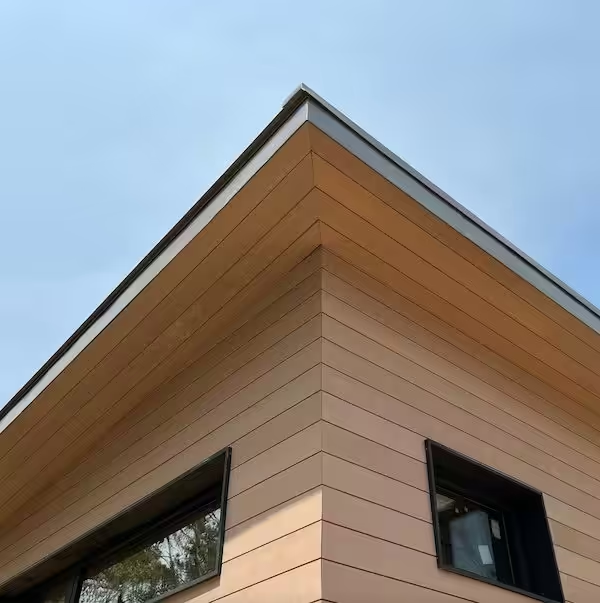
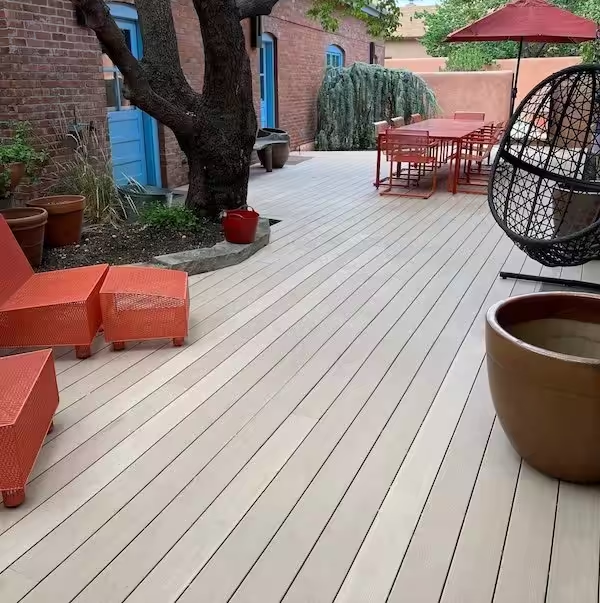
Waste-derived is the smallest category on this list and the one moving fastest. The leading example in US cladding is rice-hull composite. Rice mills generate hulls as a milling byproduct at enormous scale, and a large share of that stream still ends up burned or landfilled. ACRE, made by Modern Mill, extrudes upcycled rice hulls into boards that cut, rout, and fasten like wood: tree-free siding, trim, and decking produced in McComb, Mississippi from locally sourced hulls.
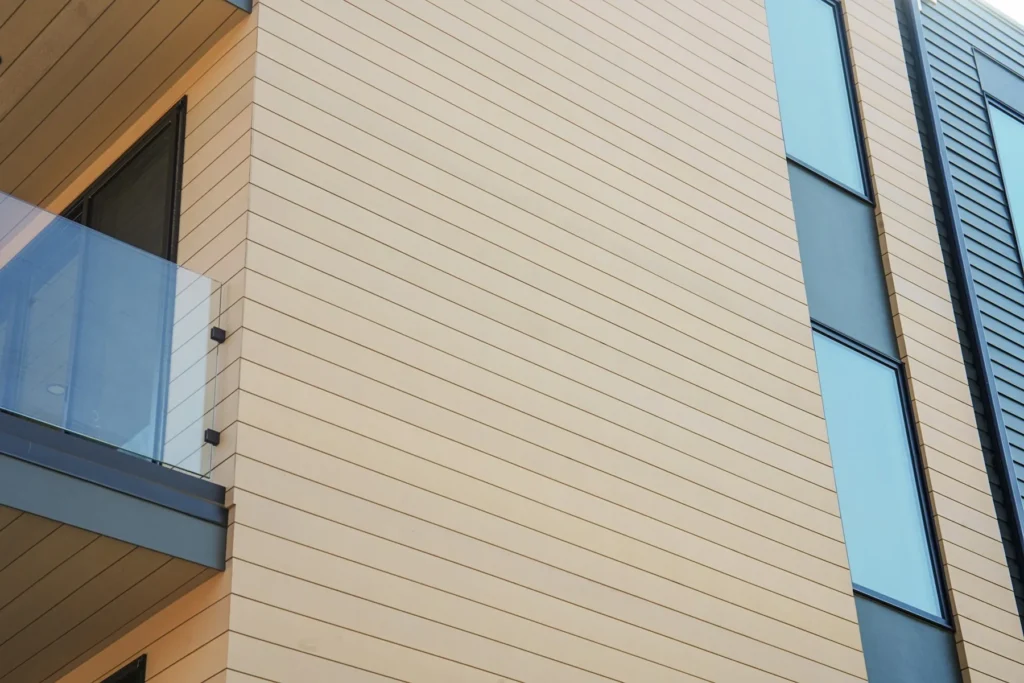
Architects evaluate a waste-derived composite the way they evaluate any young material: feedstock, then composition, then documentation, then track record. So here is the honest scorecard.
The feedstock case is strong, and domestic manufacturing keeps transport carbon short. Composition gets the same scrutiny this guide applies to every composite: ACRE's rice hulls are bound in a rigid PVC-based resin matrix, which the manufacturer discloses in its own product FAQ (along with what the formulation omits: no phthalates, phenol, formaldehyde, or adhesives). For material-health screening that distinction matters in both directions – rigid PVC omits the phthalate plasticizers found in flexible PVC products, but a strict Red List filter treats chlorinated polymers as a class, so a project chasing Living Building status will screen a PVC-bound board the same way it screens vinyl. The end-of-life questions this guide put to wood-plastic composites apply here too: the board is a fused blend with no established municipal recovery stream (the manufacturer lists recycling options on request), and fire behavior should be verified against the specific profile's test data.
On documentation, rice-hull composite does not yet have a published third-party EPD; if your project chases EPD credits, request current environmental documentation from the manufacturer and confirm what exists at submittal time. On track record, the material has years on walls, not decades. The Lifetime Limited Warranty covers manufacturing defects, not weathering, so judge longevity from samples and test data rather than the warranty page.
That is more caveat than most vendors print about their own material. The reason waste-derived boards still belong on the shortlist is the column nothing else on this list fills: a feedstock that consumes an agricultural byproduct instead of trees, virgin resin alone, or the recycling bin's limited supply. De-risk the rest the usual way: order physical samples, run weathering and fastening trials, and write the basis-of-design around the performance attributes you verified.
Conventional Claddings Through the Same Lens
The materials architects already specify deserve the same six-criteria scoring, because two of them are routinely mislabeled – one as green, one as villain.
Fiber Cement
Fiber cement earns its reputation on durability: service lives commonly cited at 30 to 50 years, non-combustible ratings, and immunity to rot and termites. The sustainability problem sits upstream. Portland cement production is carbon-intensive, which places fiber cement cladding in the middle-to-high band of embodied carbon, and removed boards go to landfill; there is no practical recycling stream. Cutting also releases crystalline silica, a jobsite health control issue rather than an occupant one. Durable, yes. Low-carbon, no.
Vinyl
Vinyl is the complicated one. On paper its numbers look better than its reputation: the vinyl siding industry EPD reports 4.95 kg CO2e per square meter for raw material through manufacturing (modules A1-A3), one of the lowest published figures in the category, largely because the product is so light.
So why does nearly every green building framework still screen it out? Because the objections were never about factory-gate carbon. PVC is a chlorinated polymer flagged for lifecycle toxicity concerns, it sheds toxic smoke in fires, practical recycling is minimal, and service lives run shorter than the durable options here. Vinyl is the clearest case for scoring all six criteria instead of one.
Brick and Terracotta
Fired clay sits at the heavy end of embodied carbon per square meter, with manufacturing energy as the driver. What it buys, per the industry's own technical notes: 100-year service lives, a 1-hour fire rating from a 4-inch veneer alone, and regionally short supply chains in most US metros. On a 60-year building, brick's amortized footprint looks far better than its first-cost carbon suggests.
Natural Cedar
Cedar is the baseline bio-based cladding and the most climate-sensitive entry here. In dry regions it delivers decades; in wet ones it demands a maintenance cycle most owners will not sustain, and replacement carbon stacks up fast. If cedar's look is the goal but the maintenance math fails, the alternatives to cedar siding comparison walks through the substitutes.
Sustainable Cladding Comparison Matrix
The matrix below compresses the six criteria into the columns spec decisions actually turn on. Carbon entries are qualitative bands rather than single numbers on purpose: published EPD values vary by product, region, and study scope, so the band tells you where to focus EPD scrutiny rather than pretending one number settles it.
| Material | Category | Embodied Carbon (A1-A3, per m2) | Commonly Cited Service Life | End-of-Life Reality | Documentation | Health / Red List Watch |
|---|---|---|---|---|---|---|
| FSC-certified wood | Bio-based | Low to moderate; biogenic storage helps | 20-40 yrs, climate-dependent | Reusable, recyclable, biodegradable | FSC CoC; EPDs common | Finishes and preservatives, not the wood |
| Reclaimed wood | Bio-based (reuse) | Low; transport-dependent | Varies with species + history | Reusable again | Rarely has EPDs | Legacy coatings (test old paint) |
| Modified wood | Bio-based | Low to moderate | 30-50+ yrs; up to 50-yr warranties | Thermal: biodegradable; chemical: check product | EPDs + C2C on leading products | Low; no biocides |
| Bamboo (densified) | Bio-based | Low to moderate; offset by freight | 25+ yrs (vendor-claimed) | Limited recovery streams | EPDs on major lines | Adhesive resins in laminations |
| Cork | Bio-based | Low; carbon-negative claims at gate | 30+ yrs (vendor-claimed) | Recyclable, biodegradable | EPDs on major lines | Low |
| Recycled metal | Recycled-content | Varies widely with recycled content | 40-60+ yrs | Genuinely circular; high-value scrap | EPDs widespread | Coating chemistries |
| Recycled-plastic / WPC composite | Recycled-content | Moderate | 25-30 yrs | Single-cycle; landfill at removal | Industry EPDs on some lines | Combustibility; flame-retardant additives |
| Rice-hull composite (ACRE) | Waste-derived filler + rigid PVC binder | No EPD published; polymer-bound, expect moderate – request data | No multi-decade record; Lifetime Limited Warranty (mfg. defects only) | Fused blend; no municipal stream; recycling options on request | Spec sheets; no EPD published | Rigid PVC binder is Red List-relevant; no phthalates or formaldehyde (per manufacturer) |
| Fiber cement | Cement-bound | Moderate to high (cement-driven) | 30-50 yrs | Landfill; no recycling stream | Industry + product EPDs | Silica dust at cutting |
| Vinyl | Virgin polymer | Low at gate: 4.95 kg CO2e/m2 (industry EPD) | 20-40 yrs cited; industry EPD models 50 | Minimal practical recycling | Industry EPD | PVC is a Red List chlorinated polymer |
| Brick / terracotta | Mineral (fired) | High per m2; amortizes over century life | 100 yrs | Downcycled as fill; reclaimable | Industry EPDs | Low |
How to read it: no row wins every column. Shortlist by the two or three columns your project weights hardest, then pull product-specific EPDs for the finalists.
One column the matrix deliberately leaves out is looks. The wood-look options (cedar, modified wood, bamboo, rice-hull composite) and the mineral palette (fiber cement, brick, terracotta) carry different grain, reveal, and aging character, and aesthetics still decide more specs than carbon does. Score sustainability here, then let design intent break the ties.
LEED v4.1 MR Credits and Red-List Compliance for Cladding
Cladding can do real work toward Materials and Resources credits, and the mechanics are specific enough to plan around.
Under the LEED v4.1 EPD credit, Option 1 awards a point for using at least 20 permanently installed products from at least 5 manufacturers with qualifying disclosure. The weighting rewards better documentation: an industry-wide EPD counts as one product, while a product-specific, externally verified Type III EPD counts as 1.5 products.
Option 2 adds a second point for products with embodied carbon optimization reports, at 5 products from 3 manufacturers. Cladding, trim, and soffit lines from a documented manufacturer can contribute several of those 20 product slots at once.
The practical obstacle is the one spec writers complain about most: assembling 20 documented products when many categories still lack EPDs. That is why the documentation column in the matrix above matters as much as the carbon column – a mid-carbon product with a product-specific EPD can serve the credit math better than a low-carbon one with nothing on file. The LEED contributions breakdown covers how individual product attributes map to credits.
Material health runs on a separate track. The Living Building Challenge Red List screens out chemical classes including chlorinated polymers (PVC) and halogenated flame retardants, both of which show up in cladding and its accessories.
If a project targets LBC or uses the Red List as a screening tool, vinyl is out by definition, and so is any composite bound with a chlorinated resin – including rice-hull boards with PVC matrices. Composite formulations need ingredient transparency either way: look for Declare labels or ask manufacturers directly. Our resources for architects include the documentation requests we see most often.
One forward note: LEED v5 moves product credits toward a multi-attribute structure that values deeper carbon reductions more aggressively. Specs written today around product-specific EPDs will age well into it.
How to Read a Cladding EPD Without Getting Burned
EPDs were supposed to end greenwashing. In practice, practitioners comparing cladding EPDs find values for the same material class spread across an order of magnitude, and the spread usually traces to scope, not product.
Four checks catch most of it:
Match the modules. A1-A3 covers raw materials through the factory gate; some declarations fold in transport (A4), installation (A5), or end-of-life. Comparing an A1-A3 number against a cradle-to-grave one is the classic apples-to-oranges error.
Product-specific beats industry-average. Both are legitimate Type III declarations under ISO standards (ISO 14025), but an industry-wide EPD describes a category's typical product, not the one in your submittal.
Check the declared unit. Per square meter of installed cladding at a stated thickness and service life is comparable; per kilogram is not.
Remember what the EPD excludes. Product EPDs stop at the product. Furring, clips, rails, and fasteners carry their own embodied carbon, and an aluminum subframe can rival the panels it holds. Score the assembly, not just the board.
The reference points that make these checks practical are free. The Carbon Leadership Forum's North American material baselines publish industry-average values to benchmark any product EPD against, and the EC3 database lets you pull and filter thousands of EPDs by category before a single submittal lands.
Cost, Longevity, and Surviving Value Engineering
The most common fate of a sustainable cladding spec is not failure on the wall. It is deletion in a value-engineering meeting.
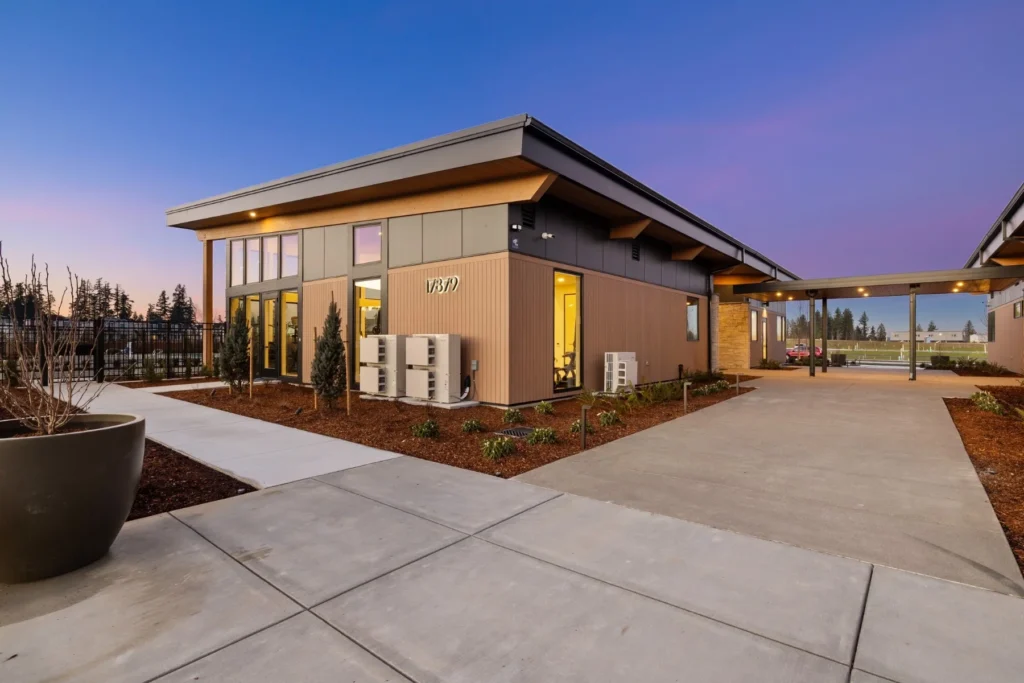
Practitioners are blunt about this: clients agree to sustainability goals in concept, then balk at even single-digit cost premiums once bids land. Bio-based and waste-derived products usually carry that premium today, so a spec that survives needs its economics framed over the building's life, not its construction loan. Durable cladding amortizes both dollars and carbon; a cheap product replaced twice does neither.
Three tactics raise survival odds. Write the basis-of-design around verified performance attributes (service life, fire data, maintenance cycle) with sustainability as the co-benefit, because performance language is harder to VE away than virtue language. Get the material priced early, before the budget hardens around a default. And put physical samples in the client's hands – a board they have held reads as a design decision, not a line item.
In our experience at Modern Mill, the specs that hold are the ones where the architect built the material into the project's identity early. That is a process advantage as much as a product one, and it applies to every material in the matrix above.
Choosing a Material You Can Defend
The architects who navigate this category well stop hunting for the single most sustainable cladding material and start ranking trade-offs against project priorities. As one practitioner put it after replacing siding on his own deep-green project: there is no solution that does it all.
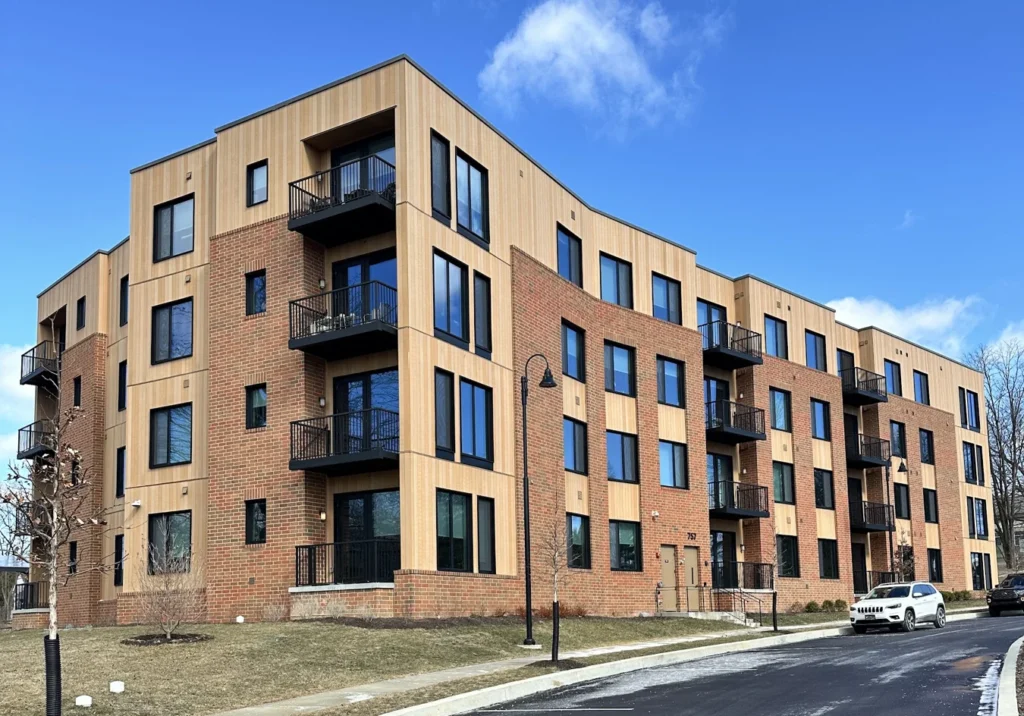
What you can do is choose with evidence, and put that evidence in the spec before the pricing conversation starts.
The next step costs five dollars. Modern Mill makes ACRE, the rice-hull cladding in the matrix above, and samples run $5 each across every siding, trim, and decking profile – an easy add to the firm's material library next to the EPDs. If a waste-derived board belongs in your comparison, judge it the way this guide suggests: in hand, against the documentation.
Frequently Asked Questions
What is the most sustainable cladding material?
There is no single winner; the answer depends on which criteria your project weights. Reclaimed wood and cork lead on embodied carbon, recycled metal leads on end-of-life circularity, brick leads on service life, and waste-derived composites lead on feedstock. Shortlist using all six criteria (feedstock, carbon, lifespan, end-of-life, documentation, material health) rather than any one label.
What are the 4 Ds of cladding design?
Deflection, drainage, drying, and durable materials – the moisture-management framework from Hazleden and Morris's wall design research. The cladding sheds most water, a drainage cavity handles what gets past, ventilation dries the rest, and the materials tolerate the moisture that remains. Sustainable material choices only perform when the wall behind them follows these four.
What cladding should you avoid on environmental grounds?
Most green building programs draw the line at vinyl, for material-health and end-of-life reasons rather than its factory-gate carbon. Architects replacing vinyl siding most often step up to fiber cement, composite boards, or pre-finished wood alternatives – the matrix above compares those swaps column by column. The more general rule: avoid any material whose green claims arrive without documentation.
Does cladding choice earn LEED points?
Yes, on two tracks. Documented products feed the EPD credit (the mechanics are in the LEED section above), and recycled content feeds Sourcing of Raw Materials, which awards points at 15 percent and 30 percent of total permanently installed material cost. A cladding package – boards, trim, soffit – is one of the easier places to bank qualifying products from a single manufacturer.
What does "carbon-negative cladding" actually mean?
It is a factory-gate accounting claim, not a building-level one. Verify it in the EPD itself: check that biogenic carbon is reported separately, that the negative number is A1-A3 only, and that the product will actually stay in service (and out of an incinerator) long enough for the storage to count. If the vendor cannot show those accounting notes, treat the label as marketing.
Ready to Experience the
Difference?
Ask for ACRE at your local lumber yard or order samples to see for yourself why builders are making the switch.